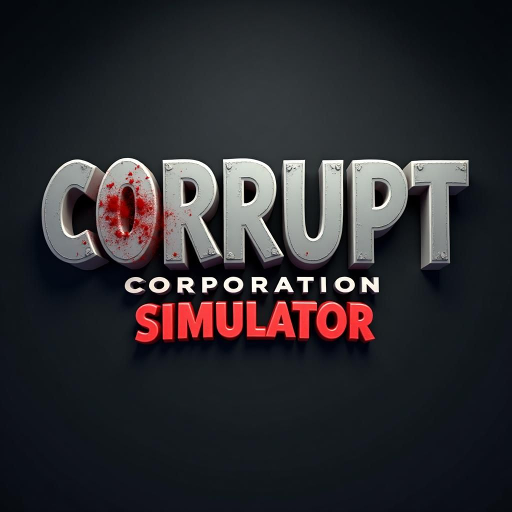

“Corrupt Corporation Simulator” sells itself as a satirical management game about running a shady empire, but the actual experience is thin, repetitive, and far less clever than the premise suggests. You’re put in the CEO chair with a “simple goal: maximize profits,” and unfortunately the design seems to have taken that simplicity as a license to avoid depth.
The core loop—manage three departments, upgrade them, choose between corruption for faster gains or “cleaning up” to avoid penalties—sounds like it should create meaningful tradeoffs. In practice, it plays like a shallow toggle between two obvious tracks. The “strategic choices” rarely feel strategic; they feel like selecting the faster progress option until the game slaps you with an inevitable penalty, then switching modes to undo it. There’s very little sense of nuance, risk management, or emergent complexity—just a blunt, gamified morality slider dressed up as corporate satire.
For a game leaning on humor and chaos, the satire is also remarkably safe. “Slightly shady empire” is the operative phrase: it gestures at corruption without committing to genuinely sharp writing, interesting scenarios, or biting commentary. The result is a tone that feels sanitized—like it wants credit for edginess while keeping everything comfortably weightless. The “humor” ends up being more of a marketing adjective than something that consistently lands in the gameplay.
Presentation-wise, “clean 3D visuals” and a “reactive UI” are nice to have, but they can’t carry a management sim that lacks satisfying systems. Watching numbers go up in real time is not inherently compelling if the underlying mechanics don’t generate hard decisions, competing constraints, or varied playstyles. After the initial novelty, it becomes an idle-ish routine of upgrades and watching capital grow, with the occasional slap-on-the-wrist penalty to pretend there’s tension.
By the time the game asks, “Will you play it safe or risk everything for massive rewards?” the honest answer is: neither feels earned. “Risk” is mostly a scripted inconvenience, “safe” is mostly slower grinding, and the empire “thriving or crumbling” lacks the drama the description promises because the player’s agency doesn’t feel consequential. It’s an accessible management game, sure—but also a forgettable one that confuses accessibility with shallowness.
☹️
Negative
1 reviews
0%
Recommended (0)
0%
Promise (0)
100%
Needs Work (1)