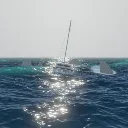
FFT Ocean
Released
GPU FFT ocean for s&box: calm to storm, lingering foam, wakes, spray and floating boats. Same waves for every player.
Code/Ocean.cs
using System;
using System.Collections.Generic;
using Sandbox.Rendering;
namespace OceanLib;
/// <summary>
/// Simulates the open ocean on the GPU, after Tessendorf's FFT method. One wind spectrum (Phillips, see
/// <see cref="OceanSpectrum"/>) is split by wave length across three cascades of different tile sizes - the swell, the
/// waves on it and the chop on those - so the sea has detail from hundreds of metres down to a hand's width, and the
/// tiles, being of unrelated sizes, never visibly repeat. Each cascade's spectrum is moved to the current time and
/// turned into a surface by an inverse FFT in compute shaders, giving two maps per cascade:
/// <see cref="Cascade.Displacement"/> (choppy x and y shift, height, shear) and <see cref="Cascade.Derivatives"/>
/// (slopes and stretch, mip-mapped for distant shading). The sea depends only on these settings and the time, so every
/// machine sees the same waves.
///
/// The sea state - wind, wave height, look - comes from an <see cref="OceanPreset"/>. The ocean can hold two at once
/// and blend between them (<see cref="BlendTo"/>, <see cref="SetBlend"/>): both are built once and kept, and the blend
/// is a number the GPU and the CPU replica each apply as they go, so a calm can build into a storm without anything
/// being rebuilt.
///
/// For physics, <see cref="HeightAt"/> and <see cref="WaterVelocityAt"/> read a CPU replica of the swell
/// (<see cref="OceanWaves"/>). The GPU work runs from a command list on the main camera at the end of each frame, for
/// the time of the next one, timed as "Ocean FFT" in the GPU profiler.
/// </summary>
[Title( "Ocean" ), Category( "Ocean" ), Icon( "waves" )]
public sealed class Ocean : Component
{
/// <summary>Waves per side of a cascade's tile. Fixed by the FFT shader's shared memory.</summary>
public const int Size = 256;
public const int CascadeCount = 3;
/// <summary>s&box units (inches) per metre. Every length the ocean exposes is in metres unless it says otherwise.</summary>
public const float UnitsPerMetre = 39.37f;
/// <summary>The sea state to start from. Empty is a moderate sea (<see cref="OceanSea.Default"/>).</summary>
[Property, Group( "Sea" )] public OceanPreset Preset { get; set; }
/// <summary>Which way the wind blows, in degrees from +x.</summary>
[Property, Group( "Sea" ), Range( 0, 360 )] public float WindAngle { get; set; } = 0.0f;
/// <summary>How tightly the waves follow the wind: 2 is Tessendorf's, higher lines them up more.</summary>
[Property, Group( "Sea" ), Range( 1, 8 )] public float Directionality { get; set; } = 2.0f;
/// <summary>Waves much shorter than this, in metres, are damped out.</summary>
[Property, Group( "Sea" ), Range( 0, 2 )] public float SmallWaveCutoff { get; set; } = 0.1f;
[Property, Group( "Sea" )] public int Seed { get; set; } = 1;
/// <summary>Metres covered by each cascade's tile, longest first. Unrelated sizes keep the tiles from lining up.</summary>
[Property, Group( "Cascades" )] public Vector3 CascadeLengths { get; set; } = new( 500.0f, 97.0f, 19.3f );
/// <summary>
/// Where one cascade hands over to the next, in waves per tile of the finer one: each cascade keeps the waves too
/// long for the next to hold this many of.
/// </summary>
[Property, Group( "Cascades" ), Range( 2, 16 )] public float BandSplit { get; set; } = 12.0f;
/// <summary>Seconds after which the sea repeats exactly - long enough that nobody notices.</summary>
[Property, Group( "Time" )] public float LoopPeriod { get; set; } = 200.0f;
[Property, Group( "Time" ), Range( 0, 4 )] public float TimeScale { get; set; } = 1.0f;
/// <summary>One tile size of the sea and the maps the FFT writes for it.</summary>
public sealed class Cascade
{
/// <summary>Metres covered by the tile.</summary>
public float TileLength { get; init; }
/// <summary>Choppy x and y shift and height, in metres, and the shear dDx/dy in w.</summary>
public Texture Displacement { get; init; }
/// <summary>Slope of the height in x and y, and the stretch of the shift along x and y. Mip-mapped.</summary>
public Texture Derivatives { get; init; }
internal Texture SpectrumA { get; init; }
internal Texture SpectrumB { get; init; }
}
/// <summary>One sea state, built: each cascade's initial spectrum, on the CPU and on the GPU.</summary>
public sealed class SpectrumSet
{
public OceanSpectrum[] Spectra { get; init; }
public OceanSea Sea { get; init; }
internal Texture[] Textures { get; init; }
internal static SpectrumSet Create( OceanSpectrum[] spectra, OceanSea sea )
{
var textures = new Texture[spectra.Length];
for ( int i = 0; i < spectra.Length; i++ )
{
textures[i] = Texture.Create( Size, Size, ImageFormat.RGBA32323232F )
.WithUAVBinding()
.WithData<Vector4>( spectra[i].Texels.AsSpan() )
.WithName( $"Ocean Initial Spectrum {i}" )
.Finish();
}
return new SpectrumSet { Spectra = spectra, Sea = sea, Textures = textures };
}
/// <summary>The sea part way between two states, exactly as the blend shows it.</summary>
internal static SpectrumSet Lerp( SpectrumSet a, SpectrumSet b, float t )
{
var spectra = new OceanSpectrum[a.Spectra.Length];
for ( int i = 0; i < spectra.Length; i++ )
spectra[i] = OceanSpectrum.Lerp( a.Spectra[i], b.Spectra[i], t );
return Create( spectra, OceanSea.Lerp( a.Sea, b.Sea, t ) );
}
}
/// <summary>The cascades, longest waves first.</summary>
public Cascade[] Cascades { get; private set; } = Array.Empty<Cascade>();
/// <summary>The two sea states being blended, and how far from the first to the second.</summary>
public SpectrumSet From { get; private set; }
public SpectrumSet To { get; private set; }
public float Blend { get; private set; }
/// <summary>The sea as it is now, between the two states being blended.</summary>
public OceanSea Sea => From is null ? StartSea : OceanSea.Lerp( From.Sea, To.Sea, Blend );
/// <summary>The time, wrapped to the loop period, the maps currently show.</summary>
public float OceanTime { get; private set; }
/// <summary>The sea replayed on the CPU, for physics: see <see cref="OceanWaves"/>.</summary>
public OceanWaves Waves { get; private set; }
/// <summary>The first active ocean in the scene: what floating things float on.</summary>
public static Ocean Current { get; private set; }
/// <summary>
/// The sea's time at this very moment, wrapped to the loop period: unlike <see cref="OceanTime"/>, which steps
/// once a frame, it moves on between the physics steps of a frame too.
/// </summary>
public float PhysicsTime => (float)((m_Time + (Time.Now - m_TimeTakenAt) * TimeScale) % LoopPeriod + LoopPeriod) % LoopPeriod;
/// <summary>Which way the wind blows, as a unit vector across the sea.</summary>
public Vector3 WindDirection => Rotation.FromYaw( WindAngle ).Forward;
/// <summary>The height of the sea's surface over a point in the world, in world units. The mean level is z = 0.</summary>
public float HeightAt( Vector3 world )
{
if ( Waves is null )
return 0.0f;
return Waves.HeightAt( ToMetres( world ), PhysicsTime, Sea.Choppiness ) * UnitsPerMetre;
}
/// <summary>
/// Where the water that lies over a point at rest has been carried by the waves, in world units: sideways along
/// the orbit and up or down.
/// </summary>
public Vector3 DisplacementAt( Vector3 world )
{
if ( Waves is null )
return Vector3.Zero;
return Waves.Displacement( ToMetres( world ), PhysicsTime, Sea.Choppiness ) * UnitsPerMetre;
}
/// <summary>
/// How fast the water at the surface near a point is moving, in world units per second: the orbit each bit of
/// water swings round as a wave passes - forward on the crest, back in the trough - which is what carries a
/// floating thing along. From the swell's displacement a moment apart.
/// </summary>
public Vector3 WaterVelocityAt( Vector3 world )
{
if ( Waves is null )
return Vector3.Zero;
// Without the choppiness: that pinches the crests for the eye, and would carry the water round its orbit nearly
// twice as fast as a real sea does.
const float dt = 0.05f;
var metres = ToMetres( world );
float t = PhysicsTime;
var now = Waves.Displacement( metres, t, 1.0f );
var next = Waves.Displacement( metres, t + dt, 1.0f );
return (next - now) / dt * UnitsPerMetre;
}
/// <summary>
/// Moves the sea to another state over some seconds, from wherever it is now - even part way through another
/// blend. Zero seconds switches at once.
/// </summary>
public void BlendTo( OceanPreset preset, float seconds )
{
if ( !m_Driven )
m_From = StartSea;
// Part way through a blend: what shows now becomes the start of the new one, so nothing jumps.
if ( From is not null && Blend > 0.0f )
{
var snapshot = SpectrumSet.Lerp( From, To, Blend );
DropSnapshot();
m_Snapshot = snapshot;
m_From = snapshot.Sea;
}
m_To = preset?.Sea ?? OceanSea.Default;
m_Blend = 0.0f;
m_Rate = seconds > 0.0f ? 1.0f / seconds : float.PositiveInfinity;
m_Driven = true;
}
/// <summary>
/// Holds the sea at a fixed point between two states: 0 is all of the first, 1 all of the second. For a slider or
/// anything else that drives the blend itself every frame.
/// </summary>
public void SetBlend( OceanPreset from, OceanPreset to, float blend )
{
DropSnapshot();
m_From = from?.Sea ?? OceanSea.Default;
m_To = to?.Sea ?? OceanSea.Default;
m_Blend = blend.Clamp( 0.0f, 1.0f );
m_Rate = 0.0f;
m_Driven = true;
}
/// <summary>The tile length of a cascade, in metres.</summary>
public float LengthOf( int cascade ) => cascade switch { 0 => CascadeLengths.x, 1 => CascadeLengths.y, _ => CascadeLengths.z };
/// <summary>Hands the maps and their tile sizes to anything drawn or dispatched with the ocean's shaders.</summary>
public void Bind( RenderAttributes attributes )
{
for ( int i = 0; i < Cascades.Length; i++ )
{
attributes.Set( $"OceanDisplacement{i}", Cascades[i].Displacement );
attributes.Set( $"OceanDerivatives{i}", Cascades[i].Derivatives );
}
attributes.Set( "OceanTileLengths", CascadeLengths * UnitsPerMetre );
attributes.Set( "OceanUnitsPerMetre", UnitsPerMetre );
}
/// <summary>The same, for a command list.</summary>
public void Bind( CommandList commands )
{
for ( int i = 0; i < Cascades.Length; i++ )
{
commands.Attributes.Set( $"OceanDisplacement{i}", Cascades[i].Displacement );
commands.Attributes.Set( $"OceanDerivatives{i}", Cascades[i].Derivatives );
}
commands.Attributes.Set( "OceanTileLengths", CascadeLengths * UnitsPerMetre );
commands.Attributes.Set( "OceanUnitsPerMetre", UnitsPerMetre );
}
private ComputeShader m_TimeShader;
private ComputeShader m_FftShader;
private ComputeShader m_AssembleShader;
private CameraCommands m_Commands;
private double m_Time;
private double m_TimeTakenAt;
// Every sea state built so far, and the CPU replica for every pair blended so far.
private readonly Dictionary<OceanSea, SpectrumSet> m_Sets = new();
private readonly Dictionary<(SpectrumSet, SpectrumSet), OceanWaves> m_Replicas = new();
private int m_LayoutHash;
// What BlendTo or SetBlend asked for; until either is called, the preset is the one sea state.
private bool m_Driven;
private OceanSea m_From, m_To;
private float m_Blend, m_Rate;
// The sea as it stood when a blend was interrupted: built from the two it was between, not from settings.
private SpectrumSet m_Snapshot;
private static readonly ProfilingSampler s_Profile = new( "Ocean FFT" );
private OceanSea StartSea => Preset?.Sea ?? OceanSea.Default;
private static Vector2 ToMetres( Vector3 world ) => new Vector2( world.x, world.y ) / UnitsPerMetre;
private void DropSnapshot()
{
if ( m_Snapshot is null )
return;
foreach ( var key in m_Replicas.Keys.Where( k => k.Item1 == m_Snapshot ).ToList() )
m_Replicas.Remove( key );
m_Snapshot = null;
}
protected override void OnEnabled()
{
m_TimeShader = new ComputeShader( "ocean/shaders/ocean_timespectrum_cs.shader" );
m_FftShader = new ComputeShader( "ocean/shaders/ocean_fft_cs.shader" );
m_AssembleShader = new ComputeShader( "ocean/shaders/ocean_assemble_cs.shader" );
m_Commands = new CameraCommands( "Ocean FFT", Stage.AfterUI, 0 );
m_LayoutHash = 0;
Refresh();
Current ??= this;
}
protected override void OnDisabled()
{
if ( Current == this )
Current = null;
m_Commands?.Dispose();
m_Commands = null;
}
private static Texture CreateTarget( string name, ImageFormat format, bool mips = false )
{
var builder = Texture.Create( Size, Size, format ).WithUAVBinding().WithName( name );
return (mips ? builder.WithMips() : builder).Finish();
}
/// <summary>Brings the cascades, the two sea states and the CPU replica up to date with the settings.</summary>
private void Refresh()
{
// The tiles and the spectrum's shape set every sea state: when they change, everything built so far is stale.
int layout = HashCode.Combine( CascadeLengths, BandSplit, Seed, LoopPeriod, WindAngle, Directionality, SmallWaveCutoff );
if ( layout != m_LayoutHash || Cascades.Length != CascadeCount )
{
m_LayoutHash = layout;
m_Sets.Clear();
m_Replicas.Clear();
// An interrupted blend's snapshot was built from the old shape: start again from where it stood.
if ( m_Snapshot is not null )
{
m_From = m_Snapshot.Sea;
m_Snapshot = null;
}
var cascades = new Cascade[CascadeCount];
for ( int i = 0; i < CascadeCount; i++ )
{
var old = i < Cascades.Length ? Cascades[i] : null;
cascades[i] = new Cascade
{
TileLength = LengthOf( i ),
SpectrumA = old?.SpectrumA ?? CreateTarget( $"Ocean Spectrum A {i}", ImageFormat.RGBA32323232F ),
SpectrumB = old?.SpectrumB ?? CreateTarget( $"Ocean Spectrum B {i}", ImageFormat.RGBA32323232F ),
// Half floats: a few millimetres of precision on waves of metres, half the bandwidth to read them.
Displacement = old?.Displacement ?? CreateTarget( $"Ocean Displacement {i}", ImageFormat.RGBA16161616F ),
Derivatives = old?.Derivatives ?? CreateTarget( $"Ocean Derivatives {i}", ImageFormat.RGBA16161616F, mips: true ),
};
}
Cascades = cascades;
}
if ( !m_Driven )
m_From = m_To = StartSea;
From = m_Snapshot ?? SetFor( m_From );
To = SetFor( m_To );
Blend = From == To ? 0.0f : m_Blend;
if ( !m_Replicas.TryGetValue( (From, To), out var replica ) )
m_Replicas[(From, To)] = replica = new OceanWaves( From.Spectra[0], To.Spectra[0], LoopPeriod );
Waves = replica;
Waves.Blend = Blend;
}
/// <summary>The built sea state for some settings, building it the first time.</summary>
private SpectrumSet SetFor( OceanSea sea )
{
if ( m_Sets.TryGetValue( sea, out var set ) )
return set;
var settings = new OceanSpectrum.Settings( sea.WindSpeed, WindAngle, Directionality, SmallWaveCutoff, Seed );
var spectra = new OceanSpectrum[CascadeCount];
double variance = 0.0;
for ( int i = 0; i < CascadeCount; i++ )
{
// Each cascade takes the waves too long for the next one to hold BandSplit of; the last takes the rest.
float minK = i == 0 ? 0.0f : 2.0f * MathF.PI / LengthOf( i ) * BandSplit;
float maxK = i == CascadeCount - 1 ? float.MaxValue : 2.0f * MathF.PI / LengthOf( i + 1 ) * BandSplit;
spectra[i] = new OceanSpectrum( Size, LengthOf( i ), minK, maxK, i, settings );
variance += spectra[i].RawVariance;
}
float scale = OceanSpectrum.ScaleFor( sea.SignificantHeight, variance );
for ( int i = 0; i < CascadeCount; i++ )
spectra[i].Scale( scale );
set = SpectrumSet.Create( spectra, sea );
m_Sets[sea] = set;
return set;
}
protected override void OnUpdate()
{
if ( m_Commands is null )
return;
AdvanceBlend();
Refresh();
m_Commands.Follow( Scene );
// The maps are built at the end of this frame, for the moment the next one will show.
m_Time += Time.Delta * TimeScale;
m_TimeTakenAt = Time.Now;
OceanTime = (float)((m_Time + Time.Delta * TimeScale) % LoopPeriod);
Current ??= this;
// The CPU replica's next grid gets started on a worker thread now, so it's ready before the physics needs it.
Waves.Prefetch( PhysicsTime );
Record();
}
private void AdvanceBlend()
{
if ( m_Rate <= 0.0f )
return;
m_Blend = float.IsInfinity( m_Rate ) ? 1.0f : m_Blend.Approach( 1.0f, Time.Delta * m_Rate );
if ( m_Blend < 1.0f )
return;
// Arrived: the target is now the one sea state.
m_From = m_To;
DropSnapshot();
m_Blend = 0.0f;
m_Rate = 0.0f;
}
private void Record()
{
var cl = m_Commands.List;
cl.Reset();
using ( cl.ProfileScope( s_Profile ) )
{
cl.Attributes.Set( "OceanSize", Size );
cl.Attributes.Set( "OceanTime", OceanTime );
cl.Attributes.Set( "LoopPeriod", LoopPeriod );
cl.Attributes.Set( "Choppiness", Sea.Choppiness );
cl.Attributes.Set( "SpectrumBlend", Blend );
for ( int i = 0; i < Cascades.Length; i++ )
{
var cascade = Cascades[i];
// 1. The spectrum at this time, blended between the two sea states.
cl.Attributes.Set( "InitialSpectrum", From.Textures[i] );
cl.Attributes.Set( "InitialSpectrumB", To.Textures[i] );
cl.Attributes.Set( "SpectrumA", cascade.SpectrumA );
cl.Attributes.Set( "SpectrumB", cascade.SpectrumB );
cl.Attributes.Set( "TileLength", cascade.TileLength );
cl.DispatchCompute( m_TimeShader, Size, Size, 1 );
cl.UavBarrier( cascade.SpectrumA );
cl.UavBarrier( cascade.SpectrumB );
// 2. Inverse FFT along x, then along y: one thread group per line.
for ( int direction = 0; direction < 2; direction++ )
{
cl.Attributes.Set( "Direction", direction );
cl.DispatchCompute( m_FftShader, Size, Size, 1 );
cl.UavBarrier( cascade.SpectrumA );
cl.UavBarrier( cascade.SpectrumB );
}
// 3. The maps the surface reads, the slopes mip-mapped so distant waves shade without shimmering.
cl.Attributes.Set( "Displacement", cascade.Displacement );
cl.Attributes.Set( "Derivatives", cascade.Derivatives );
cl.DispatchCompute( m_AssembleShader, Size, Size, 1 );
cl.UavBarrier( cascade.Displacement );
cl.UavBarrier( cascade.Derivatives );
cl.GenerateMipMaps( cascade.Derivatives, Graphics.DownsampleMethod.Box );
}
}
}
}