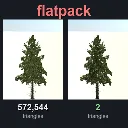
Flatpack
Released
Bakes any model into an impostor card. Thousands of props, a fraction of the GPU cost.
Editor/FlatpackLodModel.cs
This static class builds a flatpack impostor model by combining source model LOD meshes and flatcard meshes. It determines LOD switch distances based on screen space area and uses reflection to extract mesh data from the source model.
using System;
using System.Collections.Generic;
using System.IO;
using System.Linq;
using System.Reflection;
using System.Threading.Tasks;
using Editor;
using Sandbox;

namespace Flatpack.EditorTools;

/// <summary>
/// Builds a model whose last LOD is the Flatpack card: the source model's first LODs with their own materials, then the
/// card. The engine then swaps to the card by itself, like any other LOD, with no Flatpack Renderer on the object, and
/// the Clutter tool can paint it.
/// </summary>
/// <remarks>
/// <para>
/// The engine picks a LOD from the camera distance alone: LOD L shows once <c>switch[L] * scale</c> is below
/// <c>100 * distance * tan(fov / 2) / screenWidth</c> (the native metric, also in <c>clutter_cull_cs.shader</c>). Switch
/// values therefore shift with resolution and field of view; <see cref="SwitchValue"/> converts a world distance using a
/// 1920-pixel-wide, 70 degree reference view.
/// </para>
/// <para>
/// Clutter draws at most four LODs and only the first mesh of each, so the source keeps at most three LODs here and each
/// LOD is one mesh with a draw call per material.
/// </para>
/// </remarks>
public static class FlatpackLodModel
{
	/// <summary>Source LODs kept by default: Clutter draws four LODs at most, and the card takes one.</summary>
	public const int ClutterSourceLods = 3;

	const float ReferenceWidth = 1920.0f;
	const float ReferenceFov = 70.0f;

	/// <summary>
	/// The LOD switch value that makes the engine swap at <paramref name="distance"/> world units for an unscaled object,
	/// on the reference view.
	/// </summary>
	public static float SwitchValue( float distance ) =>
		100.0f * distance * MathF.Tan( ReferenceFov * 0.5f * MathF.PI / 180.0f ) / ReferenceWidth;

	/// <summary>
	/// Build the combined model. <paramref name="swapDistance"/> is where the card takes over, in world units for an
	/// unscaled object; source LODs that would switch in at or past it are dropped.
	/// </summary>
	public static Model Build( FlatpackImpostor impostor, float swapDistance, int maxSourceLods = ClutterSourceLods )
	{
		var source = impostor.SourceModel ?? throw new ArgumentException( "The impostor has no source model." );
		var info = source.MeshInfo;
		var switches = info.LodSwitchDistances;
		var cardSwitch = SwitchValue( swapDistance );

		var lods = Math.Clamp( info.LodCount, 1, Math.Max( 1, maxSourceLods ) );
		while ( lods > 1 && switches.Length > lods - 1 && switches[lods - 1] >= cardSwitch )
			lods--;

		var builder = Model.Builder.WithName( $"{source.ResourceName}_flatpack" );
		var bounds = BBox.FromPositionAndSize( impostor.Center, impostor.Radius * 2.0f );

		for ( var lod = 0; lod < lods; lod++ )
		{
			var (mesh, meshBounds) = BuildSourceLod( source, info, lod );
			builder.AddMesh( mesh, lod );
			builder.WithLodDistance( lod, lod < switches.Length ? switches[lod] : lod * 50.0f );
			bounds = bounds.AddBBox( meshBounds );
		}

		// The card from here to the last slot. Every slot gets a switch value; empty slots past the card would be picked
		// at long range and draw nothing.
		for ( var lod = lods; lod < 8; lod++ )
		{
			builder.AddMesh( FlatpackCard.BuildMesh( impostor ), lod );
			builder.WithLodDistance( lod, cardSwitch );
		}

		return builder.WithViewBounds( bounds ).Create();
	}

	/// <summary>
	/// One source LOD as a single mesh: every draw call in that LOD, one after another in shared buffers, each with its
	/// own material.
	/// </summary>
	static (Mesh Mesh, BBox Bounds) BuildSourceLod( Model source, Model.ModelMeshInfo info, int lod )
	{
		var vertices = new List<Vertex>();
		var indices = new List<int>();
		var ranges = new List<(Material Material, int Start, int Count)>();
		var bounds = new BBox( Vector3.Zero, Vector3.Zero );
		var first = true;

		for ( var m = 0; m < info.Meshes.Length; m++ )
		{
			var meshInfo = info.Meshes[m];
			if ( ((long)meshInfo.LodMask & (1L << lod)) == 0 )
				continue;

			var box = new BBox( meshInfo.BoundsMin, meshInfo.BoundsMax );
			bounds = first ? box : bounds.AddBBox( box );
			first = false;

			for ( var d = 0; d < meshInfo.DrawCalls.Length; d++ )
			{
				if ( !TryReadDrawCall( source, m, d, out var v, out var ix ) )
					continue;

				var start = indices.Count;
				var baseVertex = vertices.Count;
				vertices.AddRange( v );
				foreach ( var i in ix )
					indices.Add( (int)i + baseVertex );

				ranges.Add( (meshInfo.DrawCalls[d].Material, start, ix.Length) );
			}
		}

		if ( ranges.Count == 0 )
			throw new InvalidOperationException( $"Couldn't read LOD {lod} of {source.ResourceName}." );

		var mesh = new Mesh( ranges[0].Material );
		mesh.CreateVertexBuffer( vertices.Count, vertices );
		mesh.CreateIndexBuffer( indices.Count, indices );
		mesh.SetIndexRange( ranges[0].Start, ranges[0].Count );
		for ( var r = 1; r < ranges.Count; r++ )
			mesh.AddSubMesh( ranges[r].Material, ranges[r].Start, ranges[r].Count, 0, 0 );

		mesh.Bounds = bounds;
		return (mesh, bounds);
	}

	static MethodInfo _readDrawCall;

	/// <summary>
	/// The engine's reader for one draw call's vertices and indices. It's internal (the tools' scene compiler uses it), so
	/// it's reached by reflection; the public whole-model readers don't separate LODs or draw calls.
	/// </summary>
	static bool TryReadDrawCall( Model model, int mesh, int drawCall, out Vertex[] vertices, out uint[] indices )
	{
		_readDrawCall ??= typeof( Model ).GetMethod( "TryReadDrawCall", BindingFlags.Instance | BindingFlags.Public | BindingFlags.NonPublic );
		vertices = null;
		indices = null;
		if ( _readDrawCall is null )
			return false;

		var args = new object[] { mesh, drawCall, null, null, null };
		if ( _readDrawCall.Invoke( model, args ) is not true )
			return false;

		vertices = args[2] as Vertex[];
		indices = args[3] as uint[];
		return vertices is { Length: > 0 } && indices is { Length: > 0 };
	}

	/// <summary>
	/// Save <paramref name="model"/> as a compiled model next to the impostor's <c>.fpack</c> and load it back from disk,
	/// so scenes and Clutter can reference it by path. Returns the loaded model.
	/// </summary>
	public static async Task<Model> SaveAsync( FlatpackImpostor impostor, Model model )
	{
		var fpack = AssetSystem.FindByPath( impostor.ResourcePath ) ?? throw new InvalidOperationException( "Save the impostor first." );
		var folder = Path.GetDirectoryName( fpack.AbsolutePath );
		var name = $"{impostor.SourceModel.ResourceName}_flatpack";
		var file = Path.Combine( folder, $"{name}.vmdl_c" );

		var bytes = await model.SaveToVmdlAsync();
		await File.WriteAllBytesAsync( file, bytes );

		AssetSystem.RegisterFile( file );
		var relative = Path.Combine( Path.GetDirectoryName( impostor.ResourcePath ) ?? "", $"{name}.vmdl" ).Replace( '\\', '/' );
		return Model.Load( relative );
	}
}