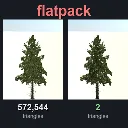
Flatpack
Released
Bakes any model into an impostor card. Thousands of props, a fraction of the GPU cost.
Editor/FlatpackQualityCheck.cs
This static class contains tools to measure the quality of texture bakes for Flatpack impostors. It renders the source model and the generated card from multiple views and distances to compare structural integrity and color accuracy.
using System;
using System.Collections.Generic;
using System.Threading;
using System.Threading.Tasks;
using Sandbox;

namespace Flatpack.EditorTools;

/// <summary>
/// Measures how closely a bake matches its model: renders both in a private scene from a few angles at a range of
/// distances and counts the pixels that differ clearly. The same test as the iteration 3 to 5 benchmarks, cut down to
/// run in a second or two after every bake.
/// </summary>
/// <remarks>
/// Both are rendered through the Albedo debug view, so lighting can't hide or invent differences: what's left is shape
/// (missing thin parts, ghosting, holes) and colour, the failures that matter most for a card. Renders are made at the
/// pixel density of a 1080p screen at 60 degrees FOV, at twice the resolution and averaged down, like the benchmarks.
/// </remarks>
public static class FlatpackQualityCheck
{
	/// <summary>A pixel counts as clearly different past this much average channel difference (of 255).</summary>
	public const int BadPixelThreshold = 25;

	/// <summary>
	/// A bake holds up at a distance when its structural difference from the model (DSSIM, 0..1) is at most this much
	/// above its own floor: the difference that's left far away, where nothing more can be gained (lighting, texture
	/// noise). Calibrated by eye in iteration 5: the chair looked right from 6 radii, the tree from 6 to 8, the knight
	/// from 8. 0.10 reproduces all three; a fixed cut-off on any single score, or a ratio to the floor, didn't.
	/// </summary>
	public const float HoldsUpExcess = 0.10f;

	/// <summary>
	/// Whatever the structure score says, more than this share of clearly wrong pixels (a wire mesh filled in solid, a
	/// missing part) doesn't hold up.
	/// </summary>
	public const float HoldsUpBadShare = 0.25f;

	/// <summary>Distances checked, in bounding radii, nearest first.</summary>
	public static readonly float[] Distances = { 1.5f, 2f, 3f, 4f, 6f, 8f, 12f, 16f, 24f, 30f };

	/// <summary>Viewing directions averaged at each distance: four sides, a little above.</summary>
	static readonly Angles[] Views = { new( 12, 35, 0 ), new( 12, 125, 0 ), new( 12, 215, 0 ), new( 12, 305, 0 ) };

	public sealed class Report
	{
		/// <summary>Share of the object's pixels that differ clearly from the model, per entry of <see cref="Distances"/>.</summary>
		public float[] BadShare { get; init; }

		/// <summary>
		/// Structural difference from the model (1 - SSIM on luminance, 0..1) per entry of <see cref="Distances"/>. Unlike
		/// <see cref="BadShare"/> this sees blur and smearing, which is what makes a card look wrong up close.
		/// </summary>
		public float[] Difference { get; init; }

		/// <summary>The card's difference far away (median of 12 to 30 radii): the floor <see cref="HoldsUpFrom"/> is judged against.</summary>
		public float Floor { get; init; }

		/// <summary>
		/// Nearest distance (bounding radii) from which every checked distance out to 16 radii holds up (see
		/// <see cref="HoldsUpExcess"/> and <see cref="HoldsUpBadShare"/>), or <see cref="float.PositiveInfinity"/> when it
		/// never does.
		/// </summary>
		public float HoldsUpFrom { get; init; }

		/// <summary>
		/// The worst share of clearly different pixels from <paramref name="radii"/> outward (to the furthest checked
		/// distance): what a card swapped in at that distance shows at its worst.
		/// </summary>
		public float WorstFrom( float radii )
		{
			var worst = BadShareAt( radii );
			for ( var i = 0; i < Distances.Length; i++ )
			{
				if ( Distances[i] >= radii && !float.IsNaN( BadShare[i] ) )
					worst = MathF.Max( worst, BadShare[i] );
			}
			return worst;
		}

		/// <summary>One line for status bars and the inspector.</summary>
		/// <summary>The bake's bounding radius in world units, for showing distances in metres.</summary>
		public float Radius { get; init; }

		public string Summary => float.IsPositiveInfinity( HoldsUpFrom )
			? $"Doesn't match the model closely inside 16 radii ({FlatpackMath.FormatMetres( 16.0f * Radius )}): keep the swap distance generous."
			: $"Looks like the model from {HoldsUpFrom:0.#} bounding radii ({FlatpackMath.FormatMetres( HoldsUpFrom * Radius )}) outward.";

		/// <summary>Share of clearly different pixels at <paramref name="radii"/>, interpolated between checked distances.</summary>
		public float BadShareAt( float radii )
		{
			if ( radii <= Distances[0] ) return BadShare[0];
			for ( var i = 1; i < Distances.Length; i++ )
			{
				if ( radii <= Distances[i] )
				{
					var t = (radii - Distances[i - 1]) / (Distances[i] - Distances[i - 1]);
					return BadShare[i - 1] + (BadShare[i] - BadShare[i - 1]) * t;
				}
			}
			return BadShare[^1];
		}
	}

	/// <summary>
	/// For see-through bakes: find the Soft Coverage strength and growth that make the card cover as much of the screen as
	/// the real model does at 8, 16 and 32 bounding radii (where cards show), from two sides, at the pixel density of a
	/// 1080p game view. Both go through the normal lit path (the debug views change how alpha-tested meshes resolve) onto
	/// a white background in an unlit scene, so a covered pixel is a dark one. Leaves the best values set on the
	/// impostor's material and returns them.
	/// </summary>
	public static async Task<(float Soft, float Growth)> FitSoftCoverageAsync( FlatpackImpostor impostor, CancellationToken cancel = default )
	{
		var strengths = new[] { 1.0f, 1.25f, 1.5f, 1.75f, 2.0f, 2.5f, 3.0f, 4.0f };
		var growths = new[] { 0.0f, 0.25f, 0.5f, 0.75f, 1.0f };
		var distances = new[] { 8f, 16f, 32f };
		var views = new[] { Views[0], Views[2] };
		var material = impostor.Material;

		var scene = Scene.CreateEditorScene();
		scene.Name = "Flatpack Coverage Fit";
		try
		{
			ModelRenderer model, card;
			CameraComponent camera;
			using ( scene.Push() )
			{
				model = new GameObject( true, "model" ).Components.Create<ModelRenderer>();
				model.Model = impostor.SourceModel;
				model.LodOverride = 0;
				card = new GameObject( true, "card" ).Components.Create<ModelRenderer>();
				card.Model = impostor.CardModel;
				camera = new GameObject( true, "camera" ).Components.Create<CameraComponent>();
				camera.BackgroundColor = Color.White;
			}

			await WarmUpAsync( scene, camera, card, impostor );

			// Each shot: framing for one distance and side, and the model's covered pixel count there.
			var shots = new List<(Vector3 Position, Rotation Rotation, float Fov, Bitmap Target, long Model)>();
			foreach ( var k in distances )
			{
				var halfAngle = MathF.Atan( 1.15f / k );
				// 1920 pixels across a 70 degree view: about 1371 pixels per unit of tangent.
				var size = Math.Clamp( (int)(1371.0f * 2.0f * MathF.Tan( halfAngle )), 24, 1024 );
				foreach ( var view in views )
				{
					var dir = view.ToRotation().Backward;
					var shot = ( impostor.Center + dir * impostor.Radius * k, Rotation.LookAt( -dir, Vector3.Up ), halfAngle * 2.0f * (180.0f / MathF.PI), new Bitmap( size, size, false ), 0L );
					shot.Item5 = Covered( await Render( scene, camera, model, card, impostor, shot.Item1, shot.Item2, shot.Item3, shot.Item4, false ) );
					shots.Add( shot );
				}
			}

			var best = (Soft: 1.0f, Growth: 1.0f, Error: double.MaxValue);
			foreach ( var soft in strengths )
			{
				foreach ( var growth in growths )
				{
					cancel.ThrowIfCancellationRequested();
					material.Set( "g_flFlatpackSoftCoverage", soft );
					material.Set( "g_flFlatpackSoftGrowth", growth );
					double error = 0;
					foreach ( var shot in shots )
					{
						var c = Covered( await Render( scene, camera, model, card, impostor, shot.Position, shot.Rotation, shot.Fov, shot.Target, true ) );
						var rel = (c - shot.Model) / (double)Math.Max( shot.Model, 1 );
						error += rel * rel;
					}
					if ( error < best.Error )
						best = (soft, growth, error);
				}
			}

			material.Set( "g_flFlatpackSoftCoverage", best.Soft );
			material.Set( "g_flFlatpackSoftGrowth", best.Growth );
			return (best.Soft, best.Growth);
		}
		finally
		{
			scene.Destroy();
		}
	}

	static async Task<Color32[]> Render( Scene scene, CameraComponent camera, ModelRenderer model, ModelRenderer card, FlatpackImpostor impostor,
		Vector3 position, Rotation rotation, float fov, Bitmap target, bool showCard )
	{
		using ( scene.Push() )
		{
			camera.FieldOfView = fov;
			camera.WorldPosition = position;
			camera.WorldRotation = rotation;
			var d = (position - impostor.Center).Length;
			camera.ZNear = MathF.Max( 0.1f, (d - impostor.Radius * 1.2f) * 0.5f );
			camera.ZFar = d + impostor.Radius * 2.0f;
			impostor.MarkAtlasesUsed();
			model.Enabled = !showCard;
			card.Enabled = showCard;
			scene.EditorTick( 0.0f, 0.0f );
			camera.RenderToBitmap( target );
		}
		await Task.Delay( 1 );
		return target.GetPixels32();
	}

	/// <summary>
	/// Render the card a few times, a frame apart, before anything is measured. Right after a bake into a new folder the
	/// new textures aren't on the GPU yet and the first renders read blank ones: in iteration 8 a chair measured from 12
	/// radii straight after its first bake, and from 4 once its textures had loaded.
	/// </summary>
	static async Task WarmUpAsync( Scene scene, CameraComponent camera, ModelRenderer card, FlatpackImpostor impostor )
	{
		var target = new Bitmap( 64, 64, false );
		var dir = new Vector3( 1.0f, 0.0f, 0.3f ).Normal;
		for ( var i = 0; i < 20; i++ )
		{
			using ( scene.Push() )
			{
				camera.FieldOfView = 40.0f;
				camera.WorldPosition = impostor.Center + dir * impostor.Radius * 4.0f;
				camera.WorldRotation = Rotation.LookAt( -dir, Vector3.Up );
				impostor.MarkAtlasesUsed();
				card.Enabled = true;
				scene.EditorTick( 0.0f, 0.0f );
				camera.RenderToBitmap( target );
			}
			await Task.Delay( 30 );
		}
	}

	/// <summary>Pixels clearly darker than the white background.</summary>
	static long Covered( Color32[] pixels )
	{
		long n = 0;
		foreach ( var p in pixels )
			if ( p.r + p.g + p.b < 600 ) n++;
		return n;
	}

	/// <summary>
	/// Compare <paramref name="impostor"/> against its source model. <paramref name="upTo"/> stops early, for a quick check
	/// at one distance (it still checks the distances below it).
	/// </summary>
	public static async Task<Report> MeasureAsync( FlatpackImpostor impostor, float upTo = float.MaxValue, CancellationToken cancel = default )
	{
		var scene = Scene.CreateEditorScene();
		scene.Name = "Flatpack Quality Check";
		var bad = new List<float>();
		var structure = new List<float>();

		try
		{
			ModelRenderer model, card;
			CameraComponent camera;

			using ( scene.Push() )
			{
				var a = new GameObject( true, "model" );
				model = a.Components.Create<ModelRenderer>();
				model.Model = impostor.SourceModel;
				model.LodOverride = 0;

				var b = new GameObject( true, "card" );
				card = b.Components.Create<ModelRenderer>();
				card.Model = impostor.CardModel;

				var eye = new GameObject( true, "camera" );
				camera = eye.Components.Create<CameraComponent>();
				camera.BackgroundColor = Color.Transparent;
				camera.DebugMode = SceneCameraDebugMode.Albedo;
			}

			await WarmUpAsync( scene, camera, card, impostor );

			var r = impostor.Radius;
			foreach ( var k in Distances )
			{
				if ( k > upTo && bad.Count > 0 )
					break;

				// Frame the bounding sphere with a little margin, at the pixel density a 1080p, 60 degree view would give.
				var halfAngle = MathF.Atan( 1.15f / k );
				var size = Math.Clamp( (int)(1080.0f * MathF.Tan( halfAngle ) / MathF.Tan( MathF.PI / 6.0f )), 24, 1024 );
				var target = new Bitmap( size * 2, size * 2, false );

				long badPixels = 0, objectPixels = 0;
				double dssimSum = 0;
				long dssimCount = 0;
				foreach ( var view in Views )
				{
					cancel.ThrowIfCancellationRequested();
					var dir = view.ToRotation().Backward;

					Color32[] m, c;
					using ( scene.Push() )
					{
						camera.FieldOfView = halfAngle * 2.0f * (180.0f / MathF.PI);
						camera.WorldPosition = impostor.Center + dir * r * k;
						camera.WorldRotation = Rotation.LookAt( -dir, Vector3.Up );
						camera.ZNear = MathF.Max( 0.1f, r * (k - 1.2f) * 0.5f );
						camera.ZFar = r * (k + 2.0f);

						impostor.MarkAtlasesUsed();
						model.Enabled = true; card.Enabled = false;
						scene.EditorTick( 0.0f, 0.0f );
						camera.RenderToBitmap( target );
						m = target.GetPixels32();

						model.Enabled = false; card.Enabled = true;
						scene.EditorTick( 0.0f, 0.0f );
						camera.RenderToBitmap( target );
						c = target.GetPixels32();
					}

					Compare( m, c, size * 2, ref badPixels, ref objectPixels );
					Structure( m, c, size * 2, ref dssimSum, ref dssimCount );
					await Task.Delay( 1 );
				}

				bad.Add( objectPixels > 0 ? badPixels / (float)objectPixels : 0.0f );
				structure.Add( dssimCount > 0 ? (float)(dssimSum / dssimCount) : 0.0f );
			}
		}
		finally
		{
			scene.Destroy();
		}

		while ( bad.Count < Distances.Length )
		{
			bad.Add( float.NaN );
			structure.Add( float.NaN );
		}

		var far = new List<float>();
		for ( var i = 0; i < Distances.Length; i++ )
			if ( Distances[i] >= 12.0f && !float.IsNaN( structure[i] ) )
				far.Add( structure[i] );
		far.Sort();
		var floor = far.Count > 0 ? far[far.Count / 2] : float.NaN;

		var holds = float.PositiveInfinity;
		for ( var i = Distances.Length - 1; i >= 0; i-- )
		{
			if ( Distances[i] > 16.0f ) continue;
			if ( float.IsNaN( bad[i] ) || float.IsNaN( floor ) || bad[i] > HoldsUpBadShare || structure[i] > floor + HoldsUpExcess ) break;
			holds = Distances[i];
		}

		return new Report { BadShare = bad.ToArray(), Difference = structure.ToArray(), Floor = floor, HoldsUpFrom = holds, Radius = impostor.Radius };
	}

	/// <summary>
	/// Average 2 x 2 blocks of both renders (a stand-in for anti-aliasing), then count object pixels that differ clearly:
	/// <list type="bullet">
	/// <item>Shape: coverage blurred over 3 x 3 pixels differs by more than a quarter. Blurring forgives a thin wire
	/// drawn one pixel over, but not a part that's missing or a see-through mesh that filled in solid.</item>
	/// <item>Colour: both cover the pixel and the colours differ by more than <see cref="BadPixelThreshold"/>.</item>
	/// </list>
	/// A pixel belongs to the object when either render covers more than half of it.
	/// </summary>
	static void Compare( Color32[] m, Color32[] c, int size, ref long badPixels, ref long objectPixels )
	{
		var half = size / 2;
		var count = half * half;
		var mCover = new float[count];
		var cCover = new float[count];
		var mRgb = new int[count * 3];
		var cRgb = new int[count * 3];

		for ( var y = 0; y < half; y++ )
		{
			for ( var x = 0; x < half; x++ )
			{
				var o = y * half + x;
				for ( var dy = 0; dy < 2; dy++ )
				{
					for ( var dx = 0; dx < 2; dx++ )
					{
						var i = (y * 2 + dy) * size + x * 2 + dx;
						var pm = m[i]; var pc = c[i];
						mCover[o] += pm.a / (4.0f * 255.0f);
						cCover[o] += pc.a / (4.0f * 255.0f);
						mRgb[o * 3] += pm.r; mRgb[o * 3 + 1] += pm.g; mRgb[o * 3 + 2] += pm.b;
						cRgb[o * 3] += pc.r; cRgb[o * 3 + 1] += pc.g; cRgb[o * 3 + 2] += pc.b;
					}
				}
			}
		}

		for ( var y = 0; y < half; y++ )
		{
			for ( var x = 0; x < half; x++ )
			{
				var o = y * half + x;
				if ( mCover[o] <= 0.5f && cCover[o] <= 0.5f )
					continue;

				objectPixels++;

				float mBlur = 0, cBlur = 0, n = 0;
				for ( var dy = -1; dy <= 1; dy++ )
				{
					for ( var dx = -1; dx <= 1; dx++ )
					{
						int yy = y + dy, xx = x + dx;
						if ( yy < 0 || yy >= half || xx < 0 || xx >= half ) continue;
						mBlur += mCover[yy * half + xx];
						cBlur += cCover[yy * half + xx];
						n++;
					}
				}

				if ( MathF.Abs( mBlur - cBlur ) / n > 0.25f )
				{
					badPixels++;
					continue;
				}

				if ( mCover[o] > 0.5f && cCover[o] > 0.5f )
				{
					var diff = (Math.Abs( mRgb[o * 3] - cRgb[o * 3] ) + Math.Abs( mRgb[o * 3 + 1] - cRgb[o * 3 + 1] ) + Math.Abs( mRgb[o * 3 + 2] - cRgb[o * 3 + 2] )) / 12.0f;
					if ( diff > BadPixelThreshold )
						badPixels++;
				}
			}
		}
	}

	/// <summary>
	/// Structural difference (1 - SSIM, Wang et al. 2004) between the two renders' luminance, Gaussian window of 1.5
	/// pixels, at half resolution like <see cref="Compare"/>. Summed over pixels near the object (either render covers
	/// something within a few pixels); uncovered pixels count as the benchmarks' mid grey.
	/// </summary>
	static void Structure( Color32[] m, Color32[] c, int size, ref double sum, ref long count )
	{
		var half = size / 2;
		var n = half * half;
		var a = new float[n];
		var b = new float[n];
		var cover = new float[n];

		for ( var y = 0; y < half; y++ )
		{
			for ( var x = 0; x < half; x++ )
			{
				float la = 0, lb = 0, cv = 0;
				for ( var dy = 0; dy < 2; dy++ )
				{
					for ( var dx = 0; dx < 2; dx++ )
					{
						var i = (y * 2 + dy) * size + x * 2 + dx;
						la += Luma( m[i] );
						lb += Luma( c[i] );
						cv += Math.Max( m[i].a, c[i].a ) / 255.0f;
					}
				}

				var o = y * half + x;
				a[o] = la * 0.25f;
				b[o] = lb * 0.25f;
				cover[o] = cv * 0.25f;
			}
		}

		var muA = Blur( a, half );
		var muB = Blur( b, half );
		var aa = new float[n];
		var bb = new float[n];
		var ab = new float[n];
		for ( var i = 0; i < n; i++ )
		{
			aa[i] = a[i] * a[i];
			bb[i] = b[i] * b[i];
			ab[i] = a[i] * b[i];
		}

		var sAA = Blur( aa, half );
		var sBB = Blur( bb, half );
		var sAB = Blur( ab, half );
		var near = Blur( cover, half );

		const float c1 = (0.01f * 255.0f) * (0.01f * 255.0f);
		const float c2 = (0.03f * 255.0f) * (0.03f * 255.0f);
		for ( var i = 0; i < n; i++ )
		{
			if ( near[i] < 0.02f )
				continue;

			var va = sAA[i] - muA[i] * muA[i];
			var vb = sBB[i] - muB[i] * muB[i];
			var cov = sAB[i] - muA[i] * muB[i];
			var ssim = ((2 * muA[i] * muB[i] + c1) * (2 * cov + c2)) / ((muA[i] * muA[i] + muB[i] * muB[i] + c1) * (va + vb + c2));
			sum += 1.0 - ssim;
			count++;
		}
	}

	static float Luma( Color32 p ) => p.a > 127 ? p.r * 0.2126f + p.g * 0.7152f + p.b * 0.0722f : 128.0f;

	static readonly float[] Kernel = MakeKernel( 1.5f, 4 );

	static float[] MakeKernel( float sigma, int radius )
	{
		var k = new float[radius * 2 + 1];
		var total = 0.0f;
		for ( var i = -radius; i <= radius; i++ )
		{
			k[i + radius] = MathF.Exp( -i * i / (2 * sigma * sigma) );
			total += k[i + radius];
		}

		for ( var i = 0; i < k.Length; i++ )
			k[i] /= total;
		return k;
	}

	/// <summary>Separable Gaussian blur of a square image, clamped at the edges.</summary>
	static float[] Blur( float[] src, int w )
	{
		var r = Kernel.Length / 2;
		var tmp = new float[src.Length];
		var dst = new float[src.Length];
		for ( var y = 0; y < w; y++ )
		{
			for ( var x = 0; x < w; x++ )
			{
				float v = 0;
				for ( var k = -r; k <= r; k++ )
					v += src[y * w + Math.Clamp( x + k, 0, w - 1 )] * Kernel[k + r];
				tmp[y * w + x] = v;
			}
		}

		for ( var y = 0; y < w; y++ )
		{
			for ( var x = 0; x < w; x++ )
			{
				float v = 0;
				for ( var k = -r; k <= r; k++ )
					v += tmp[Math.Clamp( y + k, 0, w - 1 ) * w + x] * Kernel[k + r];
				dst[y * w + x] = v;
			}
		}

		return dst;
	}
}