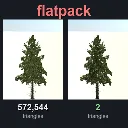
Flatpack
Released
Bakes any model into an impostor card. Thousands of props, a fraction of the GPU cost.
FlatpackMath.cs
The FlatpackMath static class provides mathematical utilities for mapping 3D viewing directions to 2D texture coordinates used by flatpack impostors. It handles encoding and decoding directional layouts (Hemisphere, Sphere, Cylinder) and calculates frame fitting based on geometric bounds.
using System;
using System.Collections.Generic;
using Sandbox;
namespace Flatpack;
/// <summary>
/// How the baked views ("frames") are spread over the directions an impostor can be seen from.
/// </summary>
public enum FlatpackLayout
{
/// <summary>
/// Hemi-octahedral: the upper half of the sphere. Best for anything that stands on the ground and is never
/// seen from below (trees, rocks, props). All N x N frames go to the half you actually see.
/// </summary>
Hemisphere = 0,
/// <summary>
/// Full octahedral: every direction. For floating or tumbling objects that can be seen from below.
/// </summary>
Sphere = 1,
/// <summary>
/// All N x N frames on the horizon, evenly around Z, and the card only turns around Z. Highest yaw
/// resolution, but it can't show the top of the object. Classic tree billboard behaviour.
/// </summary>
Cylinder = 2,
}
/// <summary>
/// The frame layout maths shared by the baker and the runtime. <c>flatpack_impostor.shader</c> has an HLSL
/// copy of the same functions; they must stay identical or the shader samples the wrong frame.
/// </summary>
/// <remarks>
/// Coordinates are Source/s&box: +X forward, +Y left, +Z up. A frame direction points from the object
/// toward the camera that captured it.
/// </remarks>
public static class FlatpackMath
{
/// <summary>
/// Maps a unit direction to the [-1, 1] square for the given layout (not used by <see cref="FlatpackLayout.Cylinder"/>).
/// </summary>
public static Vector2 EncodeOct( Vector3 d, FlatpackLayout layout )
{
if ( layout == FlatpackLayout.Hemisphere )
{
// Nothing below the horizon was baked, so clamp onto the horizon ring.
d.z = MathF.Max( d.z, 0.0f );
d = (d + new Vector3( 0, 0, 1e-5f )).Normal;
var px = d.x / (MathF.Abs( d.x ) + MathF.Abs( d.y ) + d.z);
var py = d.y / (MathF.Abs( d.x ) + MathF.Abs( d.y ) + d.z);
// Rotate the octahedron's top half by 45 degrees so it fills the whole square.
return new Vector2( px + py, px - py );
}
var sum = MathF.Abs( d.x ) + MathF.Abs( d.y ) + MathF.Abs( d.z );
var p = new Vector2( d.x / sum, d.y / sum );
if ( d.z < 0.0f )
{
// Fold the lower half out into the square's corners.
p = new Vector2( (1.0f - MathF.Abs( p.y )) * Sign( p.x ), (1.0f - MathF.Abs( p.x )) * Sign( p.y ) );
}
return p;
}
/// <summary>
/// Inverse of <see cref="EncodeOct"/>. Returns a unit direction.
/// </summary>
public static Vector3 DecodeOct( Vector2 o, FlatpackLayout layout )
{
if ( layout == FlatpackLayout.Hemisphere )
{
var px = (o.x + o.y) * 0.5f;
var py = (o.x - o.y) * 0.5f;
return new Vector3( px, py, 1.0f - MathF.Abs( px ) - MathF.Abs( py ) ).Normal;
}
var d = new Vector3( o.x, o.y, 1.0f - MathF.Abs( o.x ) - MathF.Abs( o.y ) );
if ( d.z < 0.0f )
{
d.x = (1.0f - MathF.Abs( o.y )) * Sign( o.x );
d.y = (1.0f - MathF.Abs( o.x )) * Sign( o.y );
}
return d.Normal;
}
/// <summary>
/// The direction frame (<paramref name="x"/>, <paramref name="y"/>) of an <paramref name="n"/> x <paramref name="n"/> grid is baked from.
/// </summary>
public static Vector3 FrameDirection( int x, int y, int n, FlatpackLayout layout )
{
if ( layout == FlatpackLayout.Cylinder )
{
var index = y * n + x;
var yaw = index / (float)(n * n) * MathF.Tau;
return new Vector3( MathF.Cos( yaw ), MathF.Sin( yaw ), 0.0f );
}
// Frame centres sit on the grid vertices (not cell centres), so the outer frames land exactly on the
// horizon and the shader can blend between them without extrapolating.
var o = new Vector2( x, y ) / (n - 1) * 2.0f - 1.0f;
return DecodeOct( o, layout );
}
/// <summary>
/// The camera basis a frame is captured with. Right is image +X, up is image -Y.
/// </summary>
public static void FrameBasis( Vector3 d, out Vector3 right, out Vector3 up )
{
var refUp = MathF.Abs( d.z ) < 0.999f ? Vector3.Up : Vector3.Forward;
right = Vector3.Cross( -d, refUp ).Normal;
up = Vector3.Cross( right, -d );
}
/// <summary>
/// Camera rotation for a frame. Equivalent to <see cref="FrameBasis"/> (checked in the editor: <c>Rotation.LookAt</c>
/// produces the same right and up vectors).
/// </summary>
public static Rotation FrameRotation( Vector3 d )
{
FrameBasis( d, out _, out var up );
return Rotation.LookAt( -d, up );
}
/// <summary>
/// Smallest sphere-ish bound we bake around: the box centre and its half diagonal. Not the tightest sphere,
/// but stable and cheap, and the shader only needs the frames to contain the object.
/// </summary>
public static (Vector3 Center, float Radius) BoundingSphere( BBox bounds )
{
return (bounds.Center, MathF.Max( bounds.Size.Length * 0.5f, 0.01f ));
}
/// <summary>
/// A bounding sphere fitted to points (Ritter's method): pick two far-apart points, then grow the sphere for any point
/// left outside. Within a few percent of the minimal sphere and never smaller than needed.
/// </summary>
public static (Vector3 Center, float Radius) BoundingSphere( IReadOnlyList<Vector3> points )
{
if ( points is null || points.Count == 0 )
return (Vector3.Zero, 0.01f);
var a = points[0];
var b = Farthest( points, a );
var c = Farthest( points, b );
var center = (b + c) * 0.5f;
var radius = b.Distance( c ) * 0.5f;
foreach ( var p in points )
{
var d = p.Distance( center );
if ( d <= radius )
continue;
// Move the centre toward p just enough that the new sphere still touches the old one's far side.
var newRadius = (radius + d) * 0.5f;
center += (p - center) * ((newRadius - radius) / d);
radius = newRadius;
}
// A hair of slack so silhouette texels on the sphere's rim aren't clipped by the frame edge.
return (center, MathF.Max( radius * 1.01f, 0.01f ));
}
/// <summary>
/// Metres in one world unit. s&box units are inches, as in Source; the iteration 6 distance sheet ("6 radii (21 m)"
/// for a tree 140 units in radius) used the same conversion.
/// </summary>
public const float MetresPerUnit = 0.0254f;
/// <summary>A distance in world units, in metres.</summary>
public static float ToMetres( float units ) => units * MetresPerUnit;
/// <summary>
/// A distance in world units as a reader wants it next to bounding radii: one decimal under 10 m, whole metres from
/// there ("2.5 m", "21 m"). The inspector, the bake check summary and the benchmark sheets all use this.
/// </summary>
public static string FormatMetres( float units )
{
var metres = ToMetres( units );
return metres < 10.0f
? $"{metres.ToString( "0.0", System.Globalization.CultureInfo.InvariantCulture )} m"
: $"{metres.ToString( "0", System.Globalization.CultureInfo.InvariantCulture )} m";
}
/// <summary>
/// Columns the frame lookup texture reserves for image rectangles; the depth ranges sit this far to the right.
/// The shader's <c>FlatpackFrameFit</c> reads texel (x, y) and (x + 32, y).
/// </summary>
public const int FrameFitColumns = 32;
/// <summary>
/// The bounds one frame was baked with: where the object sits inside the bounding sphere's frame, and how deep.
/// </summary>
public struct FrameFit
{
/// <summary>Top-left corner of the frame's image rectangle, in the sphere-sized frame's 0..1 image coordinates (v down).</summary>
public Vector2 Min;
/// <summary>Bottom-right corner of the image rectangle.</summary>
public Vector2 Max;
/// <summary>Height of the nearest surface along the frame direction (toward its camera), in bounding radii.</summary>
public float Near;
/// <summary>Height of the furthest surface, in bounding radii. Always below <see cref="Near"/>.</summary>
public float Far;
/// <summary>The whole bounding sphere: what every frame used before iteration 8.</summary>
public static FrameFit Sphere => new() { Min = Vector2.Zero, Max = Vector2.One, Near = 1.0f, Far = -1.0f };
}
/// <summary>
/// Fit one frame to the points it sees: their image rectangle, grown by <paramref name="padTexels"/> of a
/// <paramref name="cellTexels"/>-wide frame on every side, and their depth range. Rounded outward to the 8-bit steps the
/// lookup texture stores, so the baker renders with exactly the bounds the shader reads back.
/// </summary>
public static FrameFit FitFrame( IReadOnlyList<Vector3> points, Vector3 center, float radius, Vector3 dir, int cellTexels, int padTexels )
{
if ( points is null || points.Count == 0 )
return FrameFit.Sphere;
FrameBasis( dir, out var right, out var up );
float minU = float.MaxValue, maxU = float.MinValue, minV = float.MaxValue, maxV = float.MinValue;
float near = float.MinValue, far = float.MaxValue;
foreach ( var p in points )
{
var rel = p - center;
var u = 0.5f + Vector3.Dot( rel, right ) / (2.0f * radius);
var v = 0.5f - Vector3.Dot( rel, up ) / (2.0f * radius);
var h = Vector3.Dot( rel, dir ) / radius;
minU = MathF.Min( minU, u ); maxU = MathF.Max( maxU, u );
minV = MathF.Min( minV, v ); maxV = MathF.Max( maxV, v );
near = MathF.Max( near, h ); far = MathF.Min( far, h );
}
// Padding: the rectangle maps onto cellTexels texels, padTexels of which on each side stay outside the object.
var grow = cellTexels > 2 * padTexels + 1 ? cellTexels / (float)(cellTexels - 2 * padTexels) : 1.0f;
var padU = (maxU - minU) * (grow - 1.0f) * 0.5f;
var padV = (maxV - minV) * (grow - 1.0f) * 0.5f;
var fit = new FrameFit
{
Min = new Vector2( minU - padU, minV - padV ),
Max = new Vector2( maxU + padU, maxV + padV ),
Near = near,
Far = far,
};
return DecodeFrameFit( EncodeFrameFit( fit ) );
}
/// <summary>
/// The two lookup texels for a frame: (left, top, right) and (bottom, near, far), each value one byte, rounded outward
/// so the stored bounds always contain the real ones. Alpha stays 255 (the PNG path drops colour under low alpha).
/// </summary>
public static (Color32 Rect, Color32 Depth) EncodeFrameFit( FrameFit fit )
{
int Down( float v ) => Math.Clamp( (int)MathF.Floor( v * 255.0f + 1e-3f ), 0, 255 );
int Up( float v ) => Math.Clamp( (int)MathF.Ceiling( v * 255.0f - 1e-3f ), 0, 255 );
int minU = Down( fit.Min.x ), maxU = Up( fit.Max.x );
int minV = Down( fit.Min.y ), maxV = Up( fit.Max.y );
int near = Up( (fit.Near + 1.0f) * 0.5f ), far = Down( (fit.Far + 1.0f) * 0.5f );
// Never let a frame collapse (a flat panel seen edge-on, a plane seen face-on): keep at least two steps each way.
(minU, maxU) = Widen( minU, maxU );
(minV, maxV) = Widen( minV, maxV );
(far, near) = Widen( far, near );
return (new Color32( (byte)minU, (byte)minV, (byte)maxU, 255 ), new Color32( (byte)maxV, (byte)near, (byte)far, 255 ));
}
/// <summary>
/// The bounds two lookup texels describe. Matches the shader's <c>FlatpackFrameFit</c>.
/// </summary>
public static FrameFit DecodeFrameFit( (Color32 Rect, Color32 Depth) texels ) => new()
{
Min = new Vector2( texels.Rect.r / 255.0f, texels.Rect.g / 255.0f ),
Max = new Vector2( texels.Rect.b / 255.0f, texels.Depth.r / 255.0f ),
Near = texels.Depth.g / 255.0f * 2.0f - 1.0f,
Far = texels.Depth.b / 255.0f * 2.0f - 1.0f,
};
static (int Low, int High) Widen( int low, int high )
{
while ( high - low < 2 )
{
if ( high < 255 ) high++;
if ( high - low < 2 && low > 0 ) low--;
}
return (low, high);
}
static Vector3 Farthest( IReadOnlyList<Vector3> points, Vector3 from )
{
var best = from;
var bestDistance = -1.0f;
foreach ( var p in points )
{
var d = p.DistanceSquared( from );
if ( d > bestDistance )
{
bestDistance = d;
best = p;
}
}
return best;
}
static float Sign( float v ) => v >= 0.0f ? 1.0f : -1.0f;
}