Auto Rigger
Released
deep-learning auto-rigger for s&box. Rig Everything. (experimental)
Code/AutoRig/Dl/RigNet/SkinPipeline.cs
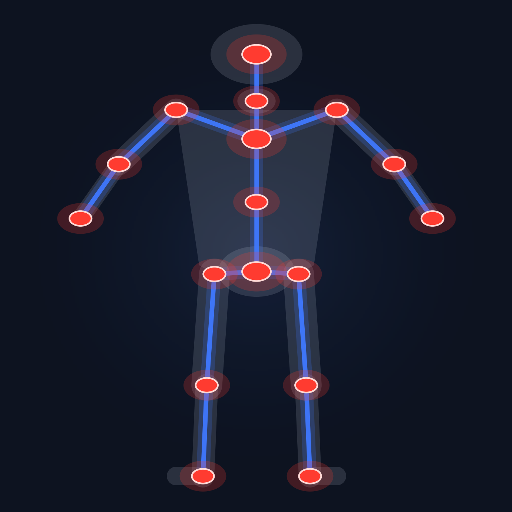
SkinPipeline contains utilities for preparing and postprocessing skinning data for a neural skinning network. It builds bones from joint hierarchy (including virtual leaf bones), constructs the network input of nearest bones and features from a geodesic distance matrix, and postprocesses logits into full per-vertex bone weights with one-ring smoothing and thresholding.
namespace AutoRig.Dl.RigNet;
using Vector3 = System.Numerics.Vector3;
/// <summary>A skinning bone: a joint-to-joint segment, or a virtual leaf bone.</summary>
public readonly record struct SkinBone( Vector3 Start, Vector3 End, int StartJoint, int EndJoint, bool IsLeaf );
/// <summary>
/// The skinning stage around SKINNET, transcribed from quick_start.predict_skinning
/// and run_skinning.post_filter: bone extraction with virtual leaf bones, the
/// 5-nearest-bone feature rows, and neighbor smoothing + thresholding of the
/// predicted weights.
/// </summary>
public static class SkinPipeline
{
/// <summary>
/// get_bones: level-order traversal emitting (parent → child) bones, plus a
/// zero-length virtual leaf bone at every childless joint.
/// </summary>
public static SkinBone[] GetBones( Vector3[] joints, int[] parents )
{
var root = Array.IndexOf( parents, -1 );
var children = new List<int>[joints.Length];
for ( var i = 0; i < joints.Length; i++ )
children[i] = new List<int>();
for ( var i = 0; i < joints.Length; i++ )
if ( parents[i] >= 0 )
children[parents[i]].Add( i );
var bones = new List<SkinBone>();
var level = new List<int> { root };
while ( level.Count > 0 )
{
var next = new List<int>();
foreach ( var p in level )
{
next.AddRange( children[p] );
foreach ( var c in children[p] )
{
bones.Add( new SkinBone( joints[p], joints[c], p, c, IsLeaf: false ) );
if ( children[c].Count == 0 )
bones.Add( new SkinBone( joints[c], joints[c], c, c, IsLeaf: true ) );
}
}
level = next;
}
return bones.ToArray();
}
/// <summary>
/// Builds SKINNET's [N, 40] input plus the per-vertex nearest-bone ids and the
/// loss mask, from a [N, B] vertex→bone volumetric geodesic distance matrix.
/// Bones sort ascending by distance (ties → lower bone id).
/// </summary>
public static (Tensor Input, int[,] NearestBones, float[,] Mask) BuildSkinInput(
SkinBone[] bones, float[,] geoDist )
{
var vertexCount = geoDist.GetLength( 0 );
var input = new float[vertexCount * SkinNet.NearestBones * SkinNet.FeaturesPerBone];
var nearest = new int[vertexCount, SkinNet.NearestBones];
var mask = new float[vertexCount, SkinNet.NearestBones];
var order = new int[bones.Length];
var distances = new float[bones.Length];
for ( var v = 0; v < vertexCount; v++ )
{
for ( var b = 0; b < bones.Length; b++ )
{
order[b] = b;
distances[b] = geoDist[v, b];
}
Array.Sort( order, ( a, b ) =>
distances[a] != distances[b] ? distances[a].CompareTo( distances[b] ) : a.CompareTo( b ) );
var baseIndex = v * SkinNet.NearestBones * SkinNet.FeaturesPerBone;
for ( var i = 0; i < SkinNet.NearestBones; i++ )
{
// Fewer bones than slots → repeat the nearest with mask 0.
var bone = i < bones.Length ? order[i] : order[0];
var at = baseIndex + i * SkinNet.FeaturesPerBone;
input[at + 0] = bones[bone].Start.X;
input[at + 1] = bones[bone].Start.Y;
input[at + 2] = bones[bone].Start.Z;
input[at + 3] = bones[bone].End.X;
input[at + 4] = bones[bone].End.Y;
input[at + 5] = bones[bone].End.Z;
input[at + 6] = 1f / (distances[bone] + 1e-10f);
input[at + 7] = bones[bone].IsLeaf ? 1f : 0f;
nearest[v, i] = i < bones.Length ? bone : 0;
mask[v, i] = i < bones.Length ? 1f : 0f;
}
}
return (Tensor.From( input, vertexCount, SkinNet.NearestBones * SkinNet.FeaturesPerBone ),
nearest, mask);
}
/// <summary>
/// predict_skinning post-processing: softmax logits → masked weights scattered
/// to the full bone set → one-ring neighbor smoothing (post_filter) →
/// zero out < 0.35 × row max → renormalize. Returns [N, B] bone weights.
/// </summary>
public static float[,] FinalizeWeights(
Tensor logits, int[,] nearestBones, float[,] mask, int boneCount,
(int From, int To)[] tplEdges )
{
var vertexCount = logits.Shape[0];
var probabilities = logits.Softmax( 1 );
var full = new float[vertexCount, boneCount];
for ( var v = 0; v < vertexCount; v++ )
for ( var i = 0; i < SkinNet.NearestBones; i++ )
full[v, nearestBones[v, i]] = probabilities.Data[v * SkinNet.NearestBones + i] * mask[v, i];
full = SmoothOneRing( full, vertexCount, boneCount, tplEdges );
for ( var v = 0; v < vertexCount; v++ )
{
var rowMax = 0f;
for ( var b = 0; b < boneCount; b++ )
rowMax = MathF.Max( rowMax, full[v, b] );
var sum = 0f;
for ( var b = 0; b < boneCount; b++ )
{
if ( full[v, b] < rowMax * 0.35f )
full[v, b] = 0f;
sum += full[v, b];
}
for ( var b = 0; b < boneCount; b++ )
full[v, b] /= sum + 1e-10f;
}
return full;
}
/// <summary>post_filter(num_ring=1): replace each row with the mean of its
/// one-ring neighbors (self excluded; kept as-is when isolated).</summary>
static float[,] SmoothOneRing(
float[,] weights, int vertexCount, int boneCount, (int From, int To)[] tplEdges )
{
var neighbors = new HashSet<int>[vertexCount];
for ( var v = 0; v < vertexCount; v++ )
neighbors[v] = new HashSet<int>();
foreach ( var (from, to) in tplEdges )
{
if ( from == to )
continue;
neighbors[from].Add( to );
neighbors[to].Add( from );
}
var smoothed = new float[vertexCount, boneCount];
for ( var v = 0; v < vertexCount; v++ )
{
if ( neighbors[v].Count == 0 )
{
for ( var b = 0; b < boneCount; b++ )
smoothed[v, b] = weights[v, b];
continue;
}
foreach ( var n in neighbors[v] )
for ( var b = 0; b < boneCount; b++ )
smoothed[v, b] += weights[n, b];
for ( var b = 0; b < boneCount; b++ )
smoothed[v, b] /= neighbors[v].Count;
}
return smoothed;
}
}