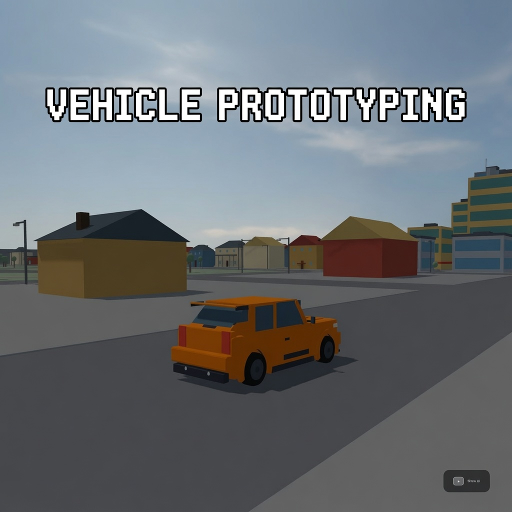
Vehicle Prototyping
Released
●1
A free, forkable driving-game baseline for s&box — a tuned car physics stack, a proving-ground track, and a playtest
Game/CarSwitcher.cs
Utility class that lets the player swap the active vehicle at runtime. It computes a ground position and heading from the outgoing car, despawns it, spawns the chosen roster car at the same spot with the appropriate seat height, transfers the assist drive mode, and rewires references (pilot.ActiveCar, chase camera target, UI rig, VehicleBridge). It also exposes a console command and helper methods for roster cycling.
namespace VehicleProto;
/// <summary>
/// Live car-swap for player-facing driving (the Tab-menu "Change vehicle" was a
/// stub). Despawns the current car and spawns the chosen roster car AT THE CURRENT ground
/// position + heading (not back at a station), then rewires every reference that pointed at the
/// old car: the pilot's <see cref="VehiclePilot.ActiveCar"/>, the chase camera, the whole HUD
/// stack (<see cref="UiRig.Retarget"/>), and <see cref="VehicleBridge.SpawnedCar"/>.
///
/// It deliberately reuses the harness spawn path rather than duplicating it: geometry comes from
/// <see cref="VehicleFactory.Spawn"/> and the seat height from <see cref="VehiclePilot.SeatHeightM"/>
/// (the ONE suspension-equilibrium formula — spawning at surface+radius flings the car).
/// Car ids resolve through <see cref="VehiclePilot.ResolveCar"/>, the canonical alias table.
///
/// Entry points: the SessionMenu picker (cycles <see cref="Roster"/>) and the <c>vp_car <id></c>
/// console command for quick testing.
/// </summary>
public static class CarSwitcher
{
/// <summary>Player-facing roster, in cycle order (hatch → coupe → kart → pickup). The separate
/// "hatchkit" slot was collapsed into "hatch" (de-Kenney sign-off 2026-07-13): hatch now spawns
/// the hatch_kit part kit directly, so a dedicated kit slot is redundant. The console command
/// accepts any id <see cref="VehiclePilot.ResolveCar"/> knows.</summary>
public static readonly string[] Roster = { "hatch", "coupe", "kart", "pickup" };
/// <summary>
/// Swap the active car to <paramref name="carId"/>, keeping the current ground XY + heading and
/// the active drive mode (assist level). Returns the new controller (null only if there is no scene).
/// </summary>
public static VehicleController SwitchTo( Scene scene, string carId, VehiclePilot pilot = null )
{
if ( scene is null )
return null;
carId = (carId ?? "").Trim().ToLowerInvariant();
var def = VehiclePilot.ResolveCar( carId ); // unknown id → hatch (canonical table)
pilot ??= scene.GetAllComponents<VehiclePilot>().FirstOrDefault();
var current = pilot?.ActiveCar;
if ( !current.IsValid() )
current = scene.GetAllComponents<VehicleController>().FirstOrDefault();
// preserve where the outgoing car sits: recover the GROUND height under it (chassis center
// minus its own suspension-equilibrium seat height), keep XY, and flatten rotation to a pure
// heading so the new car never inherits a tilt/roll. Also carry the ACTIVE drive mode (assist
// level) forward — the outgoing car IS the live session mode holder (the SessionMenu segbar
// writes straight onto Target.Assists), so switching keeps you in Sport/Sim/Casual instead of
// snapping back to the incoming def's DefaultAssists (spawn resets it in OnAwake). null = no
// outgoing car (initial spawn) → the new car keeps its own default.
Vector3 posM = Vector3.Zero;
Rotation facing = Rotation.Identity;
AssistLevel? carryMode = null;
if ( current.IsValid() )
{
var curPosM = current.WorldPosition * Units.UnitsToMeters;
float groundZM = curPosM.z - VehiclePilot.SeatHeightM( current.Definition );
posM = curPosM.WithZ( groundZM );
var fwd = current.WorldRotation.Forward.WithZ( 0f );
facing = fwd.IsNearZeroLength ? current.WorldRotation : Rotation.LookAt( fwd.Normal, Vector3.Up );
carryMode = current.Assists;
}
// re-seat the incoming def at ITS own equilibrium height above that same ground
float m = Units.MetersToUnits;
float seatZM = VehiclePilot.SeatHeightM( def );
var pos = posM.WithZ( posM.z + seatZM ) * m;
if ( current.IsValid() )
current.GameObject.Destroy();
var carGo = VehicleFactory.Spawn( scene, def, pos, facing );
var controller = carGo.Components.Get<VehicleController>();
// re-apply the carried drive mode via the same single assignment the segbar click uses
// (Assists is a plain live-read flag — setting it IS the whole apply path, no side effects to
// duplicate). Skipped when there was no outgoing car, so the initial spawn keeps its default.
if ( carryMode.HasValue && controller.IsValid() )
controller.Assists = carryMode.Value;
// rewire every reference that pointed at the old (now-destroyed) car
if ( pilot is not null )
pilot.ActiveCar = controller;
VehicleBridge.SpawnedCar = carId;
var chase = scene.Camera?.GameObject?.Components.Get<VehicleCamera>();
if ( chase is not null )
chase.Target = controller;
UiRig.Retarget( scene, controller );
Log.Info( $"[vp] car switch -> {carId} at ({posM.x:F0},{posM.y:F0}) seatZ={seatZM:F2}m [in place]" );
return controller;
}
/// <summary>The <see cref="Roster"/> id whose definition matches <paramref name="car"/> (by
/// Definition.Name — all five roster names are distinct); falls back to "hatch".</summary>
public static string CurrentId( VehicleController car )
{
var name = car?.Definition?.Name;
if ( !string.IsNullOrEmpty( name ) )
foreach ( var id in Roster )
if ( VehiclePilot.ResolveCar( id ).Name == name )
return id;
return "hatch";
}
/// <summary>Next car in the cycle after whatever is currently active.</summary>
public static string NextId( VehicleController car )
{
int idx = System.Array.IndexOf( Roster, CurrentId( car ) );
return Roster[(idx + 1) % Roster.Length];
}
[ConCmd( "vp_car" )]
public static void VpCar( string car = "hatch" )
{
var scene = Game.ActiveScene;
if ( scene is null )
{
Log.Warning( "[vp] vp_car: no active scene (play mode not running?)" );
return;
}
SwitchTo( scene, car );
}
}