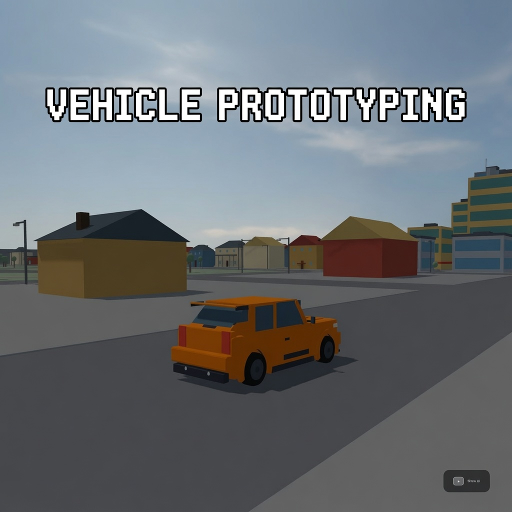
Vehicle Prototyping
Released
●1
A free, forkable driving-game baseline for s&box — a tuned car physics stack, a proving-ground track, and a playtest
UI/TuneHelpOverlay.razor
A Razor UI PanelComponent that shows a help overlay explaining tuning dials. It renders a modal with grouped dial names and short summaries, handles backdrop clicks and Escape to close, and avoids per-frame rebuilds by using a BuildHash based on UiState.TuneHelpOpen.
@using Sandbox;
@using Sandbox.UI;
@inherits PanelComponent
@namespace VehicleProto

@* Dial-explainer overlay for the Tuning panel (the "?" button in its header opens this). A short,
   plain-language summary of every tuning dial for players who aren't car experts — the condensed
   companion to docs/tuning-guide.md.

   WHY A SEPARATE PANEL (same reason as TuneRenameOverlay): TuningPanel folds live suspension load
   into its BuildHash, so it rebuilds EVERY FRAME while driving. Anything interactive placed inside it
   is torn down and recreated each frame. This overlay lives on its own PanelComponent whose BuildHash
   reads ONLY UiState.TuneHelpOpen (constant while open), so it is built once on open and never rebuilt
   mid-view — clicks land reliably.

   GLYPH-CORRUPTION DISCIPLINE (see HelpOverlay): ZERO font-size / letter-spacing; every text node is
   wrapped in a <span>, and each flex row holds ONLY element children (never a bare text node beside an
   element child) — that combination corrupted descriptions to solid blocks in past panels. *@

<root>
	@if ( UiState.TuneHelpOpen )
	{
		@* Backdrop and card wrap are SIBLINGS (TuneRenameOverlay idiom): a click on the card never bubbles
		   to the backdrop's close, so no StopPropagation is needed; a click on empty space falls through
		   the pointer-events:none wrap to the backdrop below and closes. *@
		<div class="backdrop" onclick=@Close></div>
		<div class="modalwrap">
			<div class="card">
				<div class="chead">
					<span class="title">Tuning dials — quick guide</span>
					<div class="xbtn" onclick=@Close>×</div>
				</div>
				<span class="lede">What each dial does, and which way to move it. Drag one, drive, and feel the change.</span>

				@* Scroll region. FLAT child list (sections and rows are DIRECT children of the scroller, no
				   per-group wrapper): the owner screenshot showed the first cut's rows compressed to a small
				   fixed height with text painting over the neighbours — the yoga column was squeezing its
				   (shrinkable) children into the capped height instead of scrolling. Every child here is
				   flex-shrink:0 in scss, the scroller has an EXPLICIT height and overflow-y:scroll (the
				   proven TuningPanel .plist recipe), so rows keep their natural size and the region scrolls. *@
				<div class="scrollbody">
					@foreach ( var group in GroupOrder )
					{
						<span class="section">@group</span>
						@foreach ( var d in Dials.Where( x => x.Group == group ) )
						{
							<div class="drow">
								<span class="dname">@d.Name</span>
								<span class="dsum">@d.Summary</span>
							</div>
						}
					}
				</div>

				<div class="cfoot">
					<span class="fnote">Full walkthrough: docs/tuning-guide.md</span>
					<div class="btn" onclick=@Close>Back to the dials</div>
				</div>
			</div>
		</div>
	}
</root>

@code {
	// One source of truth for the summaries (condensed from docs/tuning-guide.md — keep the two in sync).
	// Plain nested class + ctor (house idiom, mirrors TuningPanel.Param) so the target-typed new(...)
	// entries below stay terse without leaning on any record codegen.
	class DialInfo
	{
		public string Group, Name, Summary;
		public DialInfo( string group, string name, string summary )
		{
			Group = group;
			Name = name;
			Summary = summary;
		}
	}

	static readonly string[] GroupOrder = { "Engine", "Tires", "Suspension", "Assists" };

	static readonly DialInfo[] Dials =
	{
		// --- Engine ---
		new( "Engine", "Engine torque", "The engine's pulling power. Up for stronger acceleration (and more wheelspin); down for a gentler, smoother car." ),
		new( "Engine", "Final drive", "The overall gearing. Up for punchier acceleration but a lower top speed; down for taller gearing and a higher top speed." ),
		new( "Engine", "Launch boost", "Extra torque at a standstill to help you launch. Up for a harder getaway (and more wheelspin); 1× turns it off." ),
		new( "Engine", "Engine brake", "How much lifting off the throttle slows you. Up to scrub speed and settle into corners on a lift; down to coast freely." ),
		new( "Engine", "Redline", "The engine's rev ceiling. Up to pull longer in each gear; down to shift earlier. It carries the auto shift points with it." ),

		// --- Tires ---
		new( "Tires", "Grip", "Overall tire stick, for cornering and braking alike — the main \"how planted\" dial. Up for sharp and glued; down for loose and slidey." ),
		new( "Tires", "Drift grip (handbrake)", "How much rear grip is left with the handbrake pulled. Down for easy, big slides; up and the handbrake barely upsets the car." ),
		new( "Tires", "Brake torque", "Straight-line stopping power. Up for shorter stops (easier to lock up); down for longer, softer braking." ),
		new( "Tires", "Brake assist", "An extra assisted-deceleration layer on top of the brakes. Up for stronger stopping; 0 turns it off." ),
		new( "Tires", "Handbrake torque", "How hard the handbrake grabs the rear. Up for an instant, snappy lock; down for a gentler pull." ),

		// --- Suspension ---
		new( "Suspension", "Spring rate", "Suspension stiffness. Up for flat and responsive but harsher over bumps; down for soft, more roll, and a floatier ride." ),
		new( "Suspension", "Damper rate", "How fast the suspension settles. Up for tight control and less bounce; down and the car keeps bobbing." ),
		new( "Suspension", "Mass", "The car's weight. Up for stable and momentum-heavy but slower to turn and stop; down for nimble but easily unsettled." ),
		new( "Suspension", "Gravity", "How hard everything is pulled down (a whole-scene setting). Up to plant the car and land jumps heavy; down for floaty, moon-like jumps." ),

		// --- Assists ---
		new( "Assists", "Steer speed", "How fast the wheels follow your input. Up for snappy, instant steering; down for slower and smoother." ),
		new( "Assists", "Steer lock (low speed)", "Max steering angle when slow. Up for tighter turns — hairpins and parking; down for a wider circle." ),
		new( "Assists", "Steer lock (high speed)", "Max steering angle at speed (cars steer less the faster they go). Up for responsive but twitchy; down for calm and stable." ),
		new( "Assists", "Reverse speed cap", "Top speed in reverse. Up to back up faster; down to cap it lower." ),
		new( "Assists", "Spin recovery", "An assist that kills leftover motion after a spin so you point where you steer again. Up for a snappy arcade catch; 0 for a raw feel." ),
	};

	protected override void OnUpdate()
	{
		if ( !UiState.TuneHelpOpen )
			return;

		// Esc backs out of THIS overlay only (not the whole Tuning panel). CONSUME it so neither VehicleHud's
		// global "close any cursor modal" handler nor the host pause menu also fires — VehicleHud is guarded
		// to skip Esc while TuneHelpOpen is set, so this panel owns the key here.
		// (g-game-input-escapepressed-real-getset-consumable)
		if ( Input.EscapePressed )
		{
			Input.EscapePressed = false;
			Close();
		}
	}

	void Close()
	{
		UiState.TuneHelpOpen = false;
		// Cursor stays visible: the Tuning panel is still open behind us and forces it every frame.
		StateHasChanged();
	}

	// Rebuild ONLY on open/close. No live/per-frame data here — that constant-while-open hash is what keeps
	// the overlay from being torn down while you read it (mirrors TuneRenameOverlay's decoupling).
	protected override int BuildHash() => System.HashCode.Combine( UiState.TuneHelpOpen );
}