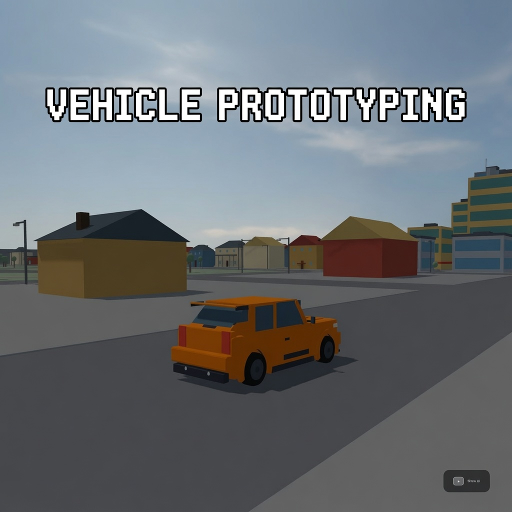
Vehicle Prototyping
Released
●1
A free, forkable driving-game baseline for s&box — a tuned car physics stack, a proving-ground track, and a playtest
Game/GameBootstrap.cs
Scene bootstrap component. Builds either the proto or playground world, spawns a default vehicle, wires the chase camera, HUD, pilot and a perf probe, and provides live world/terrain switching and console commands.
namespace VehicleProto;
/// <summary>
/// Scene entry point: builds the proving-grounds city, spawns the default car at the
/// spawn point, wires camera + HUD + tuning panel. Controls: WASD drive, Space handbrake,
/// R respawn, T tuning panel.
/// </summary>
public sealed class GameBootstrap : Component
{
/// <summary>Feature gate for in-game world switching (the World & Terrain panel + its M hotkey).
/// Disabled for now: players stay on the default Town scene and cannot switch. The dev console
/// commands (<c>vp_world</c>, <c>vp_setworld</c>) still work for internal use. Flip back to true to
/// restore the player-facing switch once the Stunt Track jump physics rework lands.
/// (static readonly, not const, so the gated call sites don't constant-fold into dead-code warnings.)</summary>
public static readonly bool WorldSwitchEnabled = false;
/// <summary>World selector (world-pass 2026-07-13). "proto" (DEFAULT) = the measurement scene:
/// CityBuilder + TestTrack with all 11 stations — the battery + vp_test.py depend on this, so it
/// MUST stay the default (vp_test never sets the ConVar). "playground" = the human-facing
/// drive space (<see cref="PlaygroundBuilder"/>): prefab buildings, wider roads, jump field, banked
/// bowl, loop track. Set it in-console before Play: <c>vp_world playground</c>.</summary>
[ConVar( "vp_world" )]
public static string World { get; set; } = "proto";
/// <summary>W4 terrain toggle for the playground world (world-pass §4 Option B). Default OFF =
/// flat plane (Option A, the safe raycast-wheel baseline). <c>vp_terrain 1</c>
/// before Play swaps in the gentle heightfield. Ignored unless vp_world=playground.</summary>
[ConVar( "vp_terrain" )]
public static bool Terrain { get; set; } = false;
/// <summary>PERF-BASELINE arming flag (Phase 0, measurement-only). Default OFF = zero behavior
/// change: the world build + car spawn run exactly as normal. When set BEFORE Play (either
/// <c>vp_perf_boot 1</c> in-console, or armed by the editor <c>vp_perf</c> tool's static write
/// before <c>play_start</c>), the one-shot build/spawn timings are wrapped in a Stopwatch and
/// logged as greppable <c>[vp] PERF BUILD/KIT</c> lines. It only measures — it never changes what
/// is built.</summary>
[ConVar( "vp_perf_boot" )]
public static bool PerfBoot { get; set; } = false;
/// <summary>Root GameObject names the three world builders create (CityBuilder="City",
/// TestTrack="Proving Grounds", PlaygroundBuilder="Playground"). A live world switch tears these
/// down by name before rebuilding — the builders are static and simply create fresh roots.</summary>
static readonly string[] WorldRootNames = { "City", "Proving Grounds", "Playground" };
// Kept so a live world switch (WorldControls panel) can rewire in place instead of remounting.
VehiclePilot _pilot;
// Session-reset the harness bridge BEFORE the pilot reads any command, so stale statics from
// a previous Play session can't make a fresh one no-op (the Play→Stop→Play stale-static trap).
protected override void OnEnabled()
{
VehicleBridge.ResetSession();
}
protected override void OnStart()
{
float m = Units.MetersToUnits;
// belt-and-braces: OnEnabled already reset, but guarantee a clean bridge before spawns.
VehicleBridge.ResetSession();
// Apply the player's saved master audio volume before anything can play a sound, so the
// persisted level takes effect on startup (not only when the Session menu is opened).
UserSettings.ApplyMasterVolume();
// s&box default gravity is Source-style ~2.2 g which bottoms out real spring
// rates; ~1.1 g keeps the suspension math honest (lesson from anywheredrive)
Scene.PhysicsWorld.Gravity = Vector3.Down * 9.81f * 1.1f * m;
// Build the selected world + spawn the default hatch (the shared path a live world switch reuses).
var controller = BuildWorldAndCar( CarDefinitions.Hatch );
var hudGo = Scene.CreateObject();
hudGo.Name = "HUD";
UiRig.Mount( hudGo, controller );
// play-mode test director: consumes vp_drive/vp_spawn bridge commands and
// drives scripted maneuvers through the controller's InputOverride seam. Seed it with the
// city car so the ConVar/first maneuver has a car even before a vp_spawn relocates it.
_pilot = Components.Create<VehiclePilot>();
_pilot.ActiveCar = controller;
// Phase-0 perf probe: created ONCE, fully inert until armed via the vp_perf channel (it applies
// no forces and samples nothing until a capture is requested). Its own GameObject so it never
// perturbs the pilot/HUD stacks.
var perfGo = Scene.CreateObject();
perfGo.Name = "PerfProbe";
perfGo.Components.Create<PerfProbe>();
Log.Info( $"[vp] boot started. v{VpBuild.Version} build {VpBuild.PublishStamp} ({VpBuild.PublishStampNote}). WASD drive, Space handbrake, R respawn, T tuning, I help, H hide HUD. Pilot ready." );
}
/// <summary>Build the selected world and spawn <paramref name="def"/> at its spawn point, wiring
/// the chase camera. Default "proto" = the measurement scene (battery-anchored; vp_test.py leaves
/// vp_world at the default); "playground" = the human-facing drive space. Records the world
/// actually built into <see cref="VehicleBridge.World"/> so the runner's fail-closed gate reads the
/// TRUE world (audit 2026-07-13 HIGH), not just a persisted ConVar. Returns the new controller.</summary>
VehicleController BuildWorldAndCar( CarDefinition def )
{
float m = Units.MetersToUnits;
bool playground = string.Equals( World, "playground", System.StringComparison.OrdinalIgnoreCase );
VehicleBridge.World = playground ? "playground" : "proto";
// Phase-0 (measurement-only): time the world build when armed. Inert by default (PerfBoot off).
var buildSw = PerfBoot ? System.Diagnostics.Stopwatch.StartNew() : null;
Vector3 spawnPosM;
Rotation spawnFacing;
if ( playground )
{
var pg = PlaygroundBuilder.Build( Scene, Terrain );
spawnPosM = pg.SpawnPosition;
spawnFacing = pg.SpawnFacing;
}
else
{
var city = CityBuilder.Build( Scene );
// proving-grounds test track, ~600 m east of the city (docs/proving-grounds.md)
TestTrack.Build( Scene, new Vector3( 600f, 0f, 0f ) );
spawnPosM = city.SpawnPosition;
spawnFacing = city.SpawnFacing;
}
if ( buildSw is not null )
Log.Info( $"[vp] PERF BUILD world={VehicleBridge.World} ms={buildSw.Elapsed.TotalMilliseconds:0.0}" );
// spawn at exact static rest height: springs already carrying the weight. Spawning at
// surface+radius instead of suspension equilibrium causes a violent launch — all four springs
// hit full compression at once (known gotcha). SeatHeightM is the ONE canonical formula.
float seatZM = VehiclePilot.SeatHeightM( def );
// Both the world spawn point (spawnPosM, authored in METRES like all layout geometry) and the
// seat-height offset are in metres; VehicleFactory.Spawn wants engine units, so convert the whole
// position at this one boundary. Proto's spawn is (0,0,0) so the conversion is a no-op for it —
// only the playground's -150 m west apron actually moves (previously it landed at unit-space -150).
var car = VehicleFactory.Spawn( Scene, def,
(spawnPosM + Vector3.Up * seatZM) * m,
spawnFacing );
var controller = car.Components.Get<VehicleController>();
VehicleBridge.SpawnedCar = CarSwitcher.CurrentId( controller );
var camGo = Scene.Camera?.GameObject;
if ( camGo is not null )
{
var chase = camGo.Components.GetOrCreate<VehicleCamera>();
chase.Target = controller;
chase.Distance = def.BodySize.x * 1.2f + 2f;
chase.Height = def.BodySize.z + 1.3f;
}
return controller;
}
/// <summary>Live world/terrain switch from the WorldControls panel (M). This is the REAL apply
/// path the public UX needs — not a silent ConVar set. It tears down the current world roots + the
/// current car, rebuilds the newly-selected world, and rewires the chase camera, the pilot, and the
/// whole HUD stack in place (the same live-surgery pattern <see cref="CarSwitcher"/> uses for cars,
/// one level up). The player's CURRENT car is preserved across the switch. <see cref="VehicleBridge.World"/>
/// is updated so the measurement-world gate in vp_test.py stays honest: after switching to playground
/// the runner refuses; after switching back to proto it passes.</summary>
public void ApplyWorld( string world, bool terrain )
{
World = string.Equals( world, "playground", System.StringComparison.OrdinalIgnoreCase ) ? "playground" : "proto";
Terrain = terrain;
// preserve the player's current car so a world switch doesn't silently reset it to the hatch.
var def = _pilot?.ActiveCar.IsValid() == true ? _pilot.ActiveCar.Definition : CarDefinitions.Hatch;
// tear down the current car FIRST — it sits above the ground we're about to delete.
if ( _pilot?.ActiveCar.IsValid() == true )
_pilot.ActiveCar.GameObject.Destroy();
// tear down the old world roots by name (collect first — don't mutate mid-enumeration).
var stale = Scene.GetAllObjects( true ).Where( go => go is not null && WorldRootNames.Contains( go.Name ) ).ToList();
foreach ( var go in stale )
go.Destroy();
var controller = BuildWorldAndCar( def );
if ( _pilot is not null )
_pilot.ActiveCar = controller;
UiRig.Retarget( Scene, controller );
Log.Info( $"[vp] world switch -> {VehicleBridge.World} terrain={Terrain}" );
}
/// <summary>Panel/console entry: find the live bootstrap and apply a world switch. Safe to call
/// with no active bootstrap (returns quietly).</summary>
public static void RequestWorld( Scene scene, string world, bool terrain )
{
var boot = scene?.GetAllComponents<GameBootstrap>().FirstOrDefault();
boot?.ApplyWorld( world, terrain );
}
/// <summary>Console parity for the M panel's world switch (handy for testing / headless UI
/// verification, where the M keypress can't be injected): <c>vp_setworld playground 1</c>. This
/// drives the IDENTICAL <see cref="RequestWorld"/> path the panel button's onclick calls.</summary>
[ConCmd( "vp_setworld" )]
public static void VpSetWorld( string world = "proto", bool terrain = false )
{
RequestWorld( Game.ActiveScene, world, terrain );
}
}