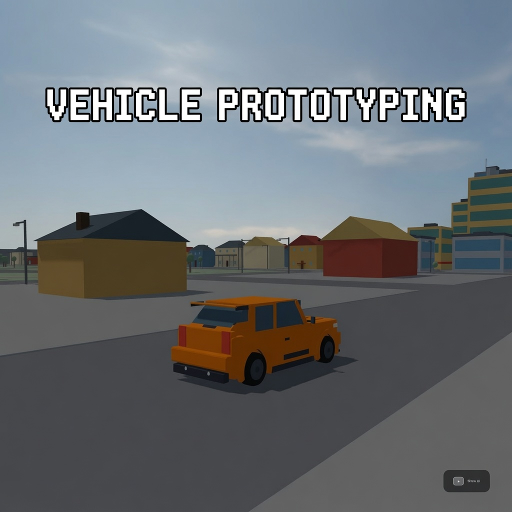
Vehicle Prototyping
Released
A free, forkable driving-game baseline for s&box — a tuned car physics stack, a proving-ground track, and a playtest
UI/CarThumb.cs
A UI ScenePanel that renders a small rotating 3D preview of a vehicle kit for a car-picker tile. It creates a detached editor Scene with camera and lights, lazily assembles model renderers for body parts and wheels from a PartKitManifest, frames the camera on the combined bounds, spins the assembled car, and falls back to a PNG thumbnail if assembly fails.
using Sandbox;
using Sandbox.UI;
using System.Collections.Generic;
namespace VehicleProto;
/// <summary>
/// One car-picker tile's 3D preview: a razor <see cref="ScenePanel"/> that renders its own
/// PRIVATE off-screen <see cref="Scene"/> holding the car's assembled part-kit body + wheels as
/// plain render <see cref="ModelRenderer"/>s, framed by the kit's bounds and slowly yaw-spinning
/// (owner: "show a small rotating 3D model of each vehicle" instead of a static PNG).
///
/// PREVIEW PATTERN (the current, non-obsolete path): a detached
/// <see cref="Scene.CreateEditorScene"/> populated with REAL GameObjects/Components (a
/// <see cref="CameraComponent"/> marked <c>IsMainCamera</c>, two <see cref="PointLight"/>s and an
/// <see cref="AmbientLight"/>, plus the car part renderers), assigned to
/// <see cref="ScenePanel.RenderScene"/>. Never use the removal-imminent
/// <c>ScenePanel.World</c>/<c>Camera</c>/<c>SceneModel</c> raw-SceneObject API. An editor scene does
/// not tick on its own, so <see cref="Scene.EditorTick"/> is pumped each frame in <see cref="Tick"/>.
///
/// ASSEMBLY: the visual mirrors <see cref="PartKitAssembler"/>'s read path but with NO physics —
/// body parts hang under a "kit body" GO rotated by <see cref="PartKitManifest.ModelToRootYaw"/> at
/// each part's <see cref="PartKitPart.AttachLocalM"/>; wheel meshes sit in the root frame at their
/// authored hub (<see cref="PartKitPart.AttachRootM"/>) with the axle-alignment yaw. No colliders,
/// no Rigidbody, no suspension/WheelVisual — purely renderers. The whole car yaws about the vertical
/// axis through the footprint centre (authoring invariant: chassis pivot = footprint-centre@ground,
/// wheels symmetric about it) so it stays centred under the fixed camera.
///
/// DECLARATIVE (gotcha: a razor COLLECTION of stateful child panels can't @ref cleanly): driven
/// entirely by markup attributes (<see cref="CarId"/>, <see cref="Selected"/>) which SessionMenu.razor
/// sets per tile; the panel reads them in its own <see cref="Tick"/>. Each tile owns its own scene.
///
/// FALLBACK: if the kit manifest/models fail to resolve, the scene stays empty and the tile falls
/// back to the existing <c>ui/cars/<id>.png</c> as a panel background (with a [vp] warning), so
/// a broken kit degrades to the old thumbnail rather than an empty box.
/// </summary>
public sealed class CarThumb : ScenePanel
{
// Slow, steady presentation spin. The selected tile turns a hair faster so the eye is drawn to
// the current pick; both stay in the calm 20-30 deg/s band the owner asked for.
const float SpinSpeedSelected = 30f; // deg/s
const float SpinSpeedIdle = 22f; // deg/s
// ---- declarative inputs (set from razor markup each render) ----
public string CarId { get; set; }
public bool Selected { get; set; }
Scene _scene; // detached off-screen preview scene (RenderScene)
GameObject _spinRoot; // the whole car; yawed each frame
float _spin; // accumulated yaw (deg)
string _builtId; // CarId currently assembled into the scene
bool _fellBack; // true once we've dropped to the PNG for this id (don't retry every frame)
public CarThumb()
{
// A detached editor scene: lives outside the game loop (never game-ticks, never networked)
// and is what the panel renders. Camera + lights are car-independent so they're built once
// here; the car itself is built lazily once CarId is known (razor sets it after construction).
_scene = Scene.CreateEditorScene();
using ( _scene.Push() )
{
// Camera looks back down +X toward the origin (the car's nose faces +X), tilted slightly
// down. Transparent background so the tile's own subtle dark styling shows behind the car.
// Placed at a nominal spot here; EnsureBuilt reframes it to the specific car's bounds.
var camGo = new GameObject( true, "thumb-camera" );
var cam = camGo.Components.GetOrCreate<CameraComponent>();
cam.WorldPosition = new Vector3( 300f, 0f, 90f );
cam.WorldRotation = Rotation.LookAt( (Vector3.Zero - camGo.WorldPosition).Normal, Vector3.Up );
cam.FieldOfView = 28f;
cam.ZNear = 1f;
cam.ZFar = 8000f;
cam.BackgroundColor = Color.Transparent;
cam.ClearFlags = ClearFlags.Color | ClearFlags.Depth | ClearFlags.Stencil;
cam.EnablePostProcessing = true;
cam.IsMainCamera = true; // the ScenePanel renders the scene's main camera
// Warm key + cool fill point lights (the engine preview-widget recipe) + a soft ambient
// so shadowed sides don't read as black. Positions are in engine units (inches).
var keyGo = new GameObject( true, "thumb-key" );
var key = keyGo.Components.GetOrCreate<PointLight>();
key.WorldPosition = new Vector3( 200f, 160f, 260f );
key.Radius = 2000f;
key.LightColor = new Color( 1f, 0.96f, 0.86f ) * 6f;
key.Shadows = false;
var fillGo = new GameObject( true, "thumb-fill" );
var fill = fillGo.Components.GetOrCreate<PointLight>();
fill.WorldPosition = new Vector3( 140f, -200f, 120f );
fill.Radius = 2000f;
fill.LightColor = new Color( 0.78f, 0.84f, 1f ) * 4f;
fill.Shadows = false;
var ambGo = new GameObject( true, "thumb-ambient" );
var amb = ambGo.Components.GetOrCreate<AmbientLight>();
amb.Color = Color.White * 0.35f;
}
RenderScene = _scene;
}
/// <summary>(Re)assemble the car when the requested id changes. Builds body parts + wheel meshes
/// from the kit manifest as plain renderers under a spin root, then frames the camera on the
/// combined bounds. On any manifest/model failure, falls back to the PNG thumbnail.</summary>
void EnsureBuilt()
{
if ( _builtId == CarId )
return; // already built (or already fell back) for this id
_builtId = CarId;
_fellBack = false;
// tear down any previous car
if ( _spinRoot.IsValid() )
_spinRoot.Destroy();
_spinRoot = null;
_spin = 0f;
Style.BackgroundImage = null;
if ( string.IsNullOrEmpty( CarId ) || !_scene.IsValid() )
return;
var def = StationCarRegistry.ResolveCar( CarId );
var kit = PartKitManifest.TryLoad( def?.PartKitManifest );
if ( kit is null )
{
FallBackToPng( $"kit manifest '{def?.PartKitManifest}' did not resolve" );
return;
}
float m = Units.MetersToUnits;
using ( _scene.Push() )
{
var spinRoot = new GameObject( true, $"thumb-{CarId}" );
int built = 0;
try
{
// ── body parts: under a "kit body" GO yawed so the model-local nose (+Y) faces root
// +X, exactly like PartKitAssembler. Each body part sits at its model-local attach. ──
var body = new GameObject( true, "kit-body" );
body.SetParent( spinRoot, false );
body.LocalRotation = PartKitManifest.ModelToRootYaw;
foreach ( var part in kit.parts )
{
if ( part.kind == "wheel" )
continue;
var model = Model.Load( part.vmdl );
if ( model is null || model.IsError )
{
if ( part.IsRequired )
throw new System.Exception( $"required part '{part.part}' model '{part.vmdl}' failed to load" );
continue; // optional cosmetic part absent — skip, same as the assembler
}
var go = new GameObject( true, $"part-{part.part}" );
go.SetParent( body, false );
go.LocalPosition = part.AttachLocalM * m;
go.LocalRotation = Rotation.Identity;
go.Components.GetOrCreate<ModelRenderer>().Model = model;
built++;
}
// ── wheels: mesh pivot is the hub centre, authored in the root frame; place at the
// authored hub with the axle-alignment yaw (mirror flag). No suspension/spin here. ──
foreach ( var wn in PartKitManifest.WheelNames )
{
var wpart = kit.Find( wn );
if ( wpart is null )
continue;
var wmodel = Model.Load( wpart.vmdl );
if ( wmodel is null || wmodel.IsError )
throw new System.Exception( $"wheel '{wn}' model '{wpart.vmdl}' failed to load" );
var wgo = new GameObject( true, $"wheel-{wn}" );
wgo.SetParent( spinRoot, false );
wgo.LocalPosition = wpart.AttachRootM * m;
wgo.LocalRotation = Rotation.FromYaw( wpart.mirror ? -90f : 90f );
wgo.Components.GetOrCreate<ModelRenderer>().Model = wmodel;
built++;
}
}
catch ( System.Exception e )
{
spinRoot.Destroy();
FallBackToPng( e.Message );
return;
}
if ( built == 0 )
{
spinRoot.Destroy();
FallBackToPng( "no parts assembled" );
return;
}
_spinRoot = spinRoot;
}
FrameCamera();
// Prime one tick so the first rendered frame is the posed car, not a half-initialised scene.
_scene.EditorTick( RealTime.Now, 0.01f );
}
/// <summary>Point the preview camera at the assembled car's combined bounds so every car fills its
/// tile consistently regardless of size (kart vs pickup). Aims at the footprint-centre vertical
/// axis (x=y=0 by the authoring invariant) so the yaw-spin never wobbles the framing.</summary>
void FrameCamera()
{
if ( !_spinRoot.IsValid() )
return;
// combined world bounds over every part renderer (car root is at identity here, pre-spin)
BBox bounds = default;
bool any = false;
foreach ( var r in _spinRoot.Components.GetAll<ModelRenderer>( FindMode.EverythingInSelfAndDescendants ) )
{
var mdl = r.Model;
if ( mdl is null )
continue;
var local = mdl.Bounds;
var t = r.WorldTransform;
for ( int c = 0; c < 8; c++ )
{
var corner = new Vector3(
(c & 1) == 0 ? local.Mins.x : local.Maxs.x,
(c & 2) == 0 ? local.Mins.y : local.Maxs.y,
(c & 4) == 0 ? local.Mins.z : local.Maxs.z );
var wp = t.PointToWorld( corner );
if ( !any ) { bounds = new BBox( wp, wp ); any = true; }
else bounds = bounds.AddPoint( wp );
}
}
if ( !any )
return;
var cam = _scene.Camera;
if ( cam is null )
return;
// Aim at the footprint-centre vertical axis at the car's mid height; radius = bounding sphere.
float aimZ = bounds.Center.z;
var center = new Vector3( 0f, 0f, aimZ );
float radius = bounds.Size.Length * 0.5f;
const float fov = 28f;
float e = 15f * MathF.PI / 180f; // slight down-tilt / 3-quarter elevation
float dist = radius / MathF.Tan( fov * 0.5f * MathF.PI / 180f ) * 1.12f;
// camera in front (+X) and above, looking back at the car centre
var dir = new Vector3( MathF.Cos( e ), 0f, MathF.Sin( e ) );
var camPos = center + dir * dist;
cam.WorldPosition = camPos;
cam.WorldRotation = Rotation.LookAt( (center - camPos).Normal, Vector3.Up );
cam.FieldOfView = fov;
}
/// <summary>Degrade this tile to the existing PNG thumbnail when the 3D kit can't be built, so a
/// broken kit never shows an empty box. Does not touch the PNG assets.</summary>
void FallBackToPng( string why )
{
_fellBack = true;
Log.Warning( $"[vp] car-thumb '{CarId}': 3D preview unavailable ({why}) — falling back to ui/cars/{CarId}.png" );
try
{
Style.BackgroundImage = Texture.LoadFromFileSystem( $"ui/cars/{CarId}.png", FileSystem.Mounted );
}
catch ( System.Exception e )
{
Log.Warning( $"[vp] car-thumb '{CarId}': PNG fallback also failed ({e.Message})" );
}
}
public override void Tick()
{
base.Tick();
if ( !_scene.IsValid() )
return;
EnsureBuilt();
if ( _fellBack || !_spinRoot.IsValid() )
return;
float dt = RealTime.Delta;
_spin += (Selected ? SpinSpeedSelected : SpinSpeedIdle) * dt;
if ( _spin >= 360f ) _spin -= 360f;
_spinRoot.WorldRotation = Rotation.FromYaw( _spin );
// An editor scene has no automatic tick; pump it so transform changes settle for the render.
_scene.EditorTick( RealTime.Now, dt );
}
public override void OnDeleted()
{
base.OnDeleted();
_spinRoot = null;
_scene?.Destroy();
_scene = null;
RenderScene = null;
}
}