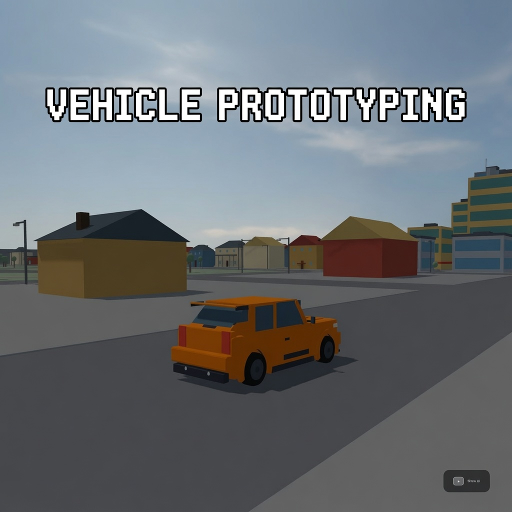
Vehicle Prototyping
Released
A free, forkable driving-game baseline for s&box — a tuned car physics stack, a proving-ground track, and a playtest
Vehicle/VehicleWheel.cs
Wheel component for a vehicle. Performs shapecast ground detection, models spring/damper suspension, computes tire slip (longitudinal and lateral) using tire curves and friction ellipse, integrates wheel angular velocity, accumulates forces across physics substeps and applies averaged force to the vehicle rigidbody each fixed update.
namespace VehicleProto;

/// <summary>
/// One wheel: shapecast ground detection + spring/damper suspension (skeleton pattern from
/// Facepunch/sbox-libwheel, MIT) with the friction model replaced by the spec §5.2.1 slip
/// physics — wheel angular velocity as integrated state, slip ratio/angle into peaked curves,
/// friction ellipse, load sensitivity, low-speed blend.
///
/// Driven by <see cref="VehicleController"/> in substeps; forces are accumulated across
/// substeps and applied once per fixed update (ApplyForceAt applies for the whole step).
/// All internal math in SI.
/// </summary>
public sealed class VehicleWheel : Component
{
	// Configured by VehicleFactory from CarDefinition
	public float Radius { get; set; } = 0.31f;
	public float Inertia { get; set; } = 1.2f;
	public float SuspensionTravel { get; set; } = 0.18f;
	public float SpringRate { get; set; } = 38000f;
	public float DamperRate { get; set; } = 2800f;
	public TireCurve LongitudinalCurve { get; set; }
	public TireCurve LateralCurve { get; set; }
	public float LoadSensitivity { get; set; } = 0.06f;
	public float StaticLoad { get; set; } = 3000f; // N, set by factory: mass·g/4
	public bool IsSteering { get; set; }
	public bool IsDriven { get; set; }
	public bool HasHandbrake { get; set; }
	public float GripScale { get; set; } = 1f; // live multiplier, e.g. handbrake drift cuts rear grip
	public float ParkBrakeScale { get; set; } = 1f; // anti-jitter stiction strength; controller fades it with throttle

	// State
	public float AngularVelocity { get; private set; } // rad/s, +forward
	public float SteerAngle { get; set; } // degrees, set by controller
	public float SlipRatio { get; private set; }
	public float SlipAngle { get; private set; } // radians
	public float Load { get; private set; } // N
	public bool IsGrounded => _trace.Hit;
	public float GroundSpeed { get; private set; } // m/s along wheel forward
	public float SuspensionLength { get; private set; } // m, attach point to wheel center, for visuals

	public string DebugTrace => !_trace.Hit
		? "miss"
		: $"{_trace.GameObject?.Name ?? "?"}{(_trace.StartedSolid ? "!SOLID" : "")} d{_trace.Distance:F1}u n{_trace.Normal.z:F2} sf{(_trace.Surface?.Friction ?? -1f):F2}";

	const float TraceSphereRadius = 1f * Units.UnitsToMeters; // shapecast sphere, see DoTrace

	Rigidbody _rigidbody;
	SceneTraceResult _trace;
	Vector3 _accumulatedForce; // N, world space
	Vector3 _forcePosition;
	int _substeps;
	float _smoothedSlipAngle;

	protected override void OnEnabled()
	{
		_rigidbody = Components.GetInAncestorsOrSelf<Rigidbody>();
	}

	/// <summary>Trace and reset accumulators. Call once per fixed update, before substeps.</summary>
	public void BeginStep()
	{
		DoTrace();
		_accumulatedForce = Vector3.Zero;
		_substeps = 0;
	}

	/// <summary>
	/// One physics substep. driveTorque/brakeTorque in N·m. Accumulates chassis force,
	/// integrates wheel spin.
	/// </summary>
	public void Substep( float dt, float driveTorque, float brakeTorque )
	{
		_substeps++;

		var up = _rigidbody.WorldRotation.Up;

		// a grazing contact (car tipped over, wheel scraping a wall) is not suspension:
		// generating spring force there self-propels a flipped car along the ground
		bool validContact = IsGrounded && Vector3.Dot( _trace.Normal, up ) > 0.4f;

		if ( !validContact )
		{
			Load = 0f;
			SlipRatio = 0f;
			SlipAngle = 0f;
			SuspensionLength = SuspensionTravel;
			IntegrateWheelSpin( dt, driveTorque, brakeTorque, 0f );
			AngularVelocity *= 1f - 0.5f * dt; // free-spinning wheels wind down in the air
			return;
		}

		// --- suspension ---
		// Force acts along the CONTACT NORMAL, not body-up: body-up creates a feedback
		// loop where a tilted car pushes itself sideways, slides, and flips.
		// Compression is clamped to physical travel: bottoming out is a rigid contact
		// for the body collider (bump stop), not unbounded spring force.
		var normal = _trace.Normal;
		float restLength = SuspensionTravel + Radius;
		float hitLength = _trace.Distance * Units.UnitsToMeters + TraceSphereRadius; // sphere stops one radius short
		float compression = Math.Clamp( restLength - hitLength, 0f, SuspensionTravel );
		SuspensionLength = Math.Clamp( hitLength - Radius, 0f, SuspensionTravel );

		var velAtWheel = _rigidbody.GetVelocityAtPoint( WorldPosition ) * Units.UnitsToMeters;
		float compressionSpeed = -Vector3.Dot( velAtWheel, normal );

		float springForce = SpringRate * compression + DamperRate * compressionSpeed;
		Load = Math.Clamp( springForce, 0f, StaticLoad * 4f );

		_accumulatedForce += normal * Load;
		_forcePosition = _trace.EndPosition;

		// --- tire frame on the contact plane ---
		var steerRot = _rigidbody.WorldRotation * Rotation.FromYaw( SteerAngle );
		var forward = (steerRot.Forward - normal * Vector3.Dot( steerRot.Forward, normal )).Normal;
		var side = Vector3.Cross( normal, forward );

		var contactVel = _rigidbody.GetVelocityAtPoint( _trace.EndPosition ) * Units.UnitsToMeters;
		float vLong = Vector3.Dot( contactVel, forward );
		float vLat = Vector3.Dot( contactVel, side );
		GroundSpeed = vLong;

		// --- slip ---
		// longitudinal uses RAW slip + a one-substep force clamp below (smoothing it added
		// ~100 ms of feedback lag that turned wheel spin into a rhythmic surge);
		// lateral keeps light relaxation, its loop is chassis-side and much slower
		float slipVelocity = AngularVelocity * Radius - vLong; // m/s at the contact patch
		SlipRatio = slipVelocity / MathF.Max( MathF.Abs( vLong ), 2.0f );

		float rawSlipAngle = MathF.Atan2( vLat, MathF.Abs( vLong ) + 0.7f );
		float relax = Math.Clamp( (MathF.Abs( vLong ) + 1f) * dt / 0.2f, 0.1f, 1f );
		_smoothedSlipAngle += (rawSlipAngle - _smoothedSlipAngle) * relax;
		SlipAngle = _smoothedSlipAngle;

		// --- forces from curves, load sensitivity, surface grip ---
		float surfaceGrip = _trace.Surface?.Friction ?? 1f;
		float loadFactor = 1f - LoadSensitivity * MathF.Max( 0f, Load / StaticLoad - 1f );
		float maxForce = Load * loadFactor * surfaceGrip * GripScale;

		float fx = LongitudinalCurve.Evaluate( SlipRatio ) * MathF.Sign( SlipRatio ) * maxForce;
		float fy = -LateralCurve.Evaluate( SlipAngle ) * MathF.Sign( SlipAngle ) * maxForce;

		// one-substep stability clamp: never push the wheel past ground-speed match within
		// a single substep (gain*dt/inertia > 2 here, the raw loop oscillates without this)
		float fxStable = MathF.Abs( slipVelocity ) * Inertia / (Radius * Radius * dt);
		fx = Math.Clamp( fx, -fxStable, fxStable );

		// --- friction ellipse (spec §5.2.1.4) ---
		float combined = MathF.Sqrt( fx * fx + fy * fy );
		if ( combined > maxForce && combined > 0.001f )
		{
			float scale = maxForce / combined;
			fx *= scale;
			fy *= scale;
		}

		// --- low-speed parking blend: kill standstill jitter ---
		// force is capped at what stops this wheel's mass share within one fixed frame
		// (spec 5.2.1.6) — uncapped, it overshoots and becomes a self-sustaining oscillator
		var planarVel = forward * vLong + side * vLat;
		float planarSpeed = planarVel.Length;
		if ( planarSpeed < 1.5f && MathF.Abs( AngularVelocity * Radius ) < 1.5f && planarSpeed > 0.001f )
		{
			// ParkBrakeScale: throttle dissolves the stiction — steered fronts were
			// "parking" against full-lock standstill launches (2 km/h crawls, tele 07-07)
			float blend = (1f - planarSpeed / 1.5f) * ParkBrakeScale;
			float massShare = StaticLoad / 9.81f; // kg carried by this wheel
			float frameDt = dt * VehicleController.Substeps;
			float stopForce = massShare * planarSpeed / frameDt * 0.8f;
			float parkMag = MathF.Min( MathF.Min( planarSpeed * Load * 1.5f, stopForce ), maxForce );

			var park = -planarVel / planarSpeed * parkMag;
			fx = fx * (1f - blend) + Vector3.Dot( park, forward ) * blend;
			fy = fy * (1f - blend) + Vector3.Dot( park, side ) * blend;
		}

		_accumulatedForce += forward * fx + side * fy;

		IntegrateWheelSpin( dt, driveTorque, brakeTorque, fx );
	}

	void IntegrateWheelSpin( float dt, float driveTorque, float brakeTorque, float tireForce )
	{
		// drive + tire reaction
		float torque = driveTorque - tireForce * Radius;
		AngularVelocity += torque / Inertia * dt;

		// brakes can stop the wheel but never reverse it within a step
		if ( brakeTorque > 0f )
		{
			float brakeDelta = brakeTorque / Inertia * dt;
			AngularVelocity = MathF.Abs( AngularVelocity ) <= brakeDelta
				? 0f
				: AngularVelocity - MathF.Sign( AngularVelocity ) * brakeDelta;
		}
	}

	/// <summary>Apply the substep-averaged force to the chassis. Call once per fixed update.</summary>
	public void EndStep()
	{
		if ( _substeps == 0 || _accumulatedForce.IsNearZeroLength )
			return;

		var averaged = _accumulatedForce / _substeps;
		_rigidbody.ApplyForceAt( _forcePosition, averaged * Units.MetersToUnits );
	}

	void DoTrace()
	{
		var down = _rigidbody.WorldRotation.Down;
		float lengthUnits = (SuspensionTravel + Radius) * Units.MetersToUnits;

		_trace = Scene.Trace
			.Radius( 1f )
			.IgnoreGameObjectHierarchy( _rigidbody.GameObject )
			.WithoutTags( "car" )
			.FromTo( WorldPosition, WorldPosition + down * lengthUnits )
			.Run();
	}
}