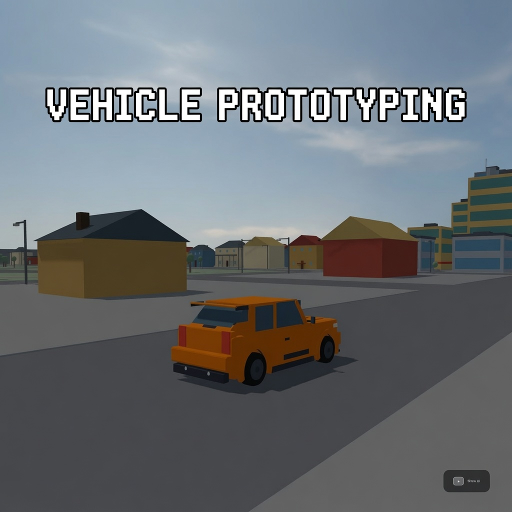
Vehicle Prototyping
Released
A free, forkable driving-game baseline for s&box — a tuned car physics stack, a proving-ground track, and a playtest
Game/CityBuilder.cs
CityBuilder for a driving proving-grounds. Builds a deterministic 10x10 block city at runtime: ground, roads, perimeter wall, and district-specific blocks (suburbs, downtown, industrial, park). Places models when available or uses colored box/sphere fallbacks; creates colliders for walls, sidewalks, poles, planters, ramps.
namespace VehicleProto;
public enum District
{
Suburbs, // NW — pastel houses (vendored village building models)
Downtown, // NE — commercial core, mini high-rises
Industrial, // SE — warehouses, ramps, containers
Park // SW — green, trees, lake
}
public class CityLayout
{
public Vector3 SpawnPosition { get; set; }
public Rotation SpawnFacing { get; set; } = Rotation.Identity;
}
/// <summary>
/// Builds a deterministic 470 m proving-grounds city block at runtime: a 10×10-block
/// grid, four quadrant districts. Fully deterministic (fixed hash of block/lot indices —
/// no runtime RNG). All building ART is custom, flat-shaded, low-poly: the vendored
/// village building set (<c>models/buildings/</c>) for the residential + industrial districts
/// and the generated mini high-rise set (<c>models/city/</c>, see tools/gen_buildings.py)
/// for the downtown commercial core. Colored dev-box fallbacks stand in if a .vmdl is
/// missing, so the map is always drivable. The drivable area is fully enclosed by solid
/// perimeter walls (no car can leave the world at any speed it reaches).
/// </summary>
public static class CityBuilder
{
const float M = Units.MetersToUnits;
public const int GridBlocks = 10;
public const float BlockSize = 36f; // m
public const float RoadWidth = 10f; // m
public const float Cell = BlockSize + RoadWidth;
public const float Total = GridBlocks * Cell + RoadWidth; // 470 m
public const float Origin = -Total * 0.5f; // map centered on world origin
static readonly Color Asphalt = new( 0.30f, 0.30f, 0.33f );
static readonly Color ParkPath = new( 0.72f, 0.66f, 0.52f );
static readonly Color Sidewalk = new( 0.62f, 0.62f, 0.64f );
static readonly Color Grass = new( 0.55f, 0.72f, 0.45f );
static readonly Color[] SuburbPalette =
{
new( 0.93f, 0.87f, 0.78f ), new( 0.85f, 0.62f, 0.52f ), new( 0.72f, 0.80f, 0.68f ),
new( 0.80f, 0.76f, 0.85f ), new( 0.95f, 0.80f, 0.62f ),
};
static readonly Color[] DowntownPalette =
{
new( 0.55f, 0.65f, 0.75f ), new( 0.75f, 0.72f, 0.68f ), new( 0.45f, 0.52f, 0.62f ),
new( 0.82f, 0.78f, 0.72f ), new( 0.60f, 0.70f, 0.72f ),
};
static readonly Color[] IndustrialPalette =
{
new( 0.62f, 0.48f, 0.40f ), new( 0.55f, 0.55f, 0.52f ), new( 0.70f, 0.45f, 0.35f ),
new( 0.50f, 0.56f, 0.58f ),
};
// Residential / village models — vendored village set (retires the Kenney suburban kit).
// Placed at NATURAL scale (they are authored at real metres); box fallback if missing.
static readonly string[] SuburbModels =
{
"models/buildings/house_small.vmdl",
"models/buildings/house_medium.vmdl",
"models/buildings/house_large.vmdl",
"models/buildings/inn.vmdl",
"models/buildings/shop.vmdl",
"models/buildings/civic_hall.vmdl",
};
// Downtown commercial core — generated art (tools/gen_buildings.py), placed at natural
// scale. Each block is PACKED with a couple of structures (pre-launch note: not one
// lonely tower per block) — one tall anchor tower + 1-3 smaller commercial fill buildings,
// arranged into block quadrants by deterministic hash. Box fallbacks if a vmdl is missing.
//
// Tower anchors: the pack subset that fits a quadrant with a comfortable gap (highrise_d
// at 18 m wide is too broad for packing, so it is left out of downtown).
static readonly string[] DowntownTowers =
{
"models/city/highrise_a.vmdl",
"models/city/highrise_b.vmdl",
"models/city/highrise_c.vmdl",
"models/city/highrise_e.vmdl",
};
// Small commercial fill (1-3 storeys) — storefronts/offices that sit beside the towers.
static readonly string[] CommercialModels =
{
"models/city/shop_a.vmdl",
"models/city/shop_b.vmdl",
"models/city/shop_c.vmdl",
"models/city/shop_d.vmdl",
};
// Industrial district — vendored work buildings (natural scale).
static readonly string[] IndustrialModels =
{
"models/buildings/warehouse.vmdl",
"models/buildings/workshop.vmdl",
"models/buildings/barn.vmdl",
};
static Scene _scene;
static GameObject _cityRoot;
public static CityLayout Build( Scene scene, int seed = 1971 )
{
_scene = scene;
_cityRoot = scene.CreateObject();
_cityRoot.Name = "City";
var layout = new CityLayout();
BuildGround();
BuildRoads();
BuildPerimeterWall();
for ( int bx = 0; bx < GridBlocks; bx++ )
for ( int by = 0; by < GridBlocks; by++ )
{
var district = DistrictOf( bx, by );
var blockMin = new Vector2( Origin + RoadWidth + bx * Cell, Origin + RoadWidth + by * Cell );
switch ( district )
{
case District.Suburbs: BuildSuburbBlock( blockMin, bx, by ); break;
case District.Downtown: BuildDowntownBlock( blockMin, bx, by ); break;
case District.Industrial: BuildIndustrialBlock( blockMin, bx, by ); break;
case District.Park: BuildParkBlock( blockMin, bx, by ); break;
}
}
// street dressing along the two main avenues (pre-launch "spruce-ups")
BuildCrosswalks();
BuildStreetlights();
// spawn: the central intersection, facing east down the main avenue
layout.SpawnPosition = new Vector3( 0f, 0f, 0f );
layout.SpawnFacing = Rotation.Identity;
Log.Info( $"[vp] city built: {GridBlocks}x{GridBlocks} blocks, {Total:F0}m span" );
return layout;
}
static District DistrictOf( int bx, int by )
{
bool west = bx < GridBlocks / 2;
bool north = by >= GridBlocks / 2;
return north
? west ? District.Suburbs : District.Downtown
: west ? District.Park : District.Industrial;
}
// Deterministic per-block hash (FNV-1a + an avalanche finalizer). No System.Random —
// the whole city (and, in the wider stack, the networking contract) requires that the
// same block coords always produce the same layout. `salt` mints an independent stream
// per decision (which quadrant is the tower, fill count, model pick, yaw), so no two
// derived values correlate. Returns a well-mixed uint the callers reduce with % / bits.
static uint Hash( int a, int b, uint salt )
{
unchecked
{
uint h = 2166136261u;
h = (h ^ (uint)a) * 16777619u;
h = (h ^ (uint)b) * 16777619u;
h = (h ^ salt) * 16777619u;
h ^= h >> 15;
h *= 0x2c1b3c6du;
h ^= h >> 12;
return h;
}
}
// ---------------------------------------------------------------- terrain & roads
static void BuildGround()
{
// one thick slab under everything — hard landings tunnel through thin colliders
var go = Child( "Ground" );
var renderer = go.Components.Create<ModelRenderer>();
renderer.MaterialOverride = Material.Load( "materials/default.vmat" );
renderer.Model = Model.Load( "models/dev/plane.vmdl" );
renderer.Tint = Grass;
go.LocalScale = new Vector3( Total * 1.2f * M / 100f, Total * 1.2f * M / 100f, 1f );
var collider = go.Components.Create<BoxCollider>();
collider.Scale = new Vector3( 100f, 100f, 200f );
collider.Center = Vector3.Down * 100f;
collider.Static = true;
go.Tags.Add( "road" );
}
static void BuildRoads()
{
// full-length strips both ways; park quadrant gets path-colored overlay strips
for ( int i = 0; i <= GridBlocks; i++ )
{
float offset = Origin + i * Cell + RoadWidth * 0.5f;
Block( new Vector3( offset, 0f, 0.01f ) * M, new Vector3( RoadWidth, Total, 0.02f ), Asphalt, collide: false, name: "Road NS" );
Block( new Vector3( 0f, offset, 0.01f ) * M, new Vector3( Total, RoadWidth, 0.02f ), Asphalt, collide: false, name: "Road EW" );
}
// dashed center line on the two main avenues through the origin
for ( int i = 0; i < 46; i++ )
{
float t = Origin + 4f + i * (Total / 46f);
Block( new Vector3( t, 0f, 0.02f ) * M, new Vector3( 2.2f, 0.25f, 0.02f ), new Color( 0.9f, 0.85f, 0.55f ), collide: false, name: "Lane" );
Block( new Vector3( 0f, t, 0.02f ) * M, new Vector3( 0.25f, 2.2f, 0.02f ), new Color( 0.9f, 0.85f, 0.55f ), collide: false, name: "Lane" );
}
}
// Solid perimeter wall enclosing the whole drivable city (the world
// must NOT be drivable-off). 8 m tall, 2 m thick, static colliders — well beyond any
// jump the cars can make, so no vehicle leaves the map at any speed it reaches. Sits
// just outside the outermost ring road; deterministic (crash-wall collider precedent).
const float WallHeight = 8f; // m
const float WallThick = 2f; // m
static void BuildPerimeterWall()
{
float edge = -Origin + RoadWidth * 0.5f + 2f; // just outside the outermost road
var wall = new Color( 0.52f, 0.52f, 0.55f );
var cap = new Color( 0.40f, 0.40f, 0.44f ); // contrasting coping so the wall reads
float len = Total + WallThick * 2f;
foreach ( var (pos, size, capPos, capSize, nm) in new[]
{
( new Vector3( 0f, edge, WallHeight * 0.5f ), new Vector3( len, WallThick, WallHeight ),
new Vector3( 0f, edge, WallHeight + 0.15f ), new Vector3( len, WallThick + 0.5f, 0.3f ), "Perimeter Wall N" ),
( new Vector3( 0f, -edge, WallHeight * 0.5f ), new Vector3( len, WallThick, WallHeight ),
new Vector3( 0f, -edge, WallHeight + 0.15f ), new Vector3( len, WallThick + 0.5f, 0.3f ), "Perimeter Wall S" ),
( new Vector3( edge, 0f, WallHeight * 0.5f ), new Vector3( WallThick, len, WallHeight ),
new Vector3( edge, 0f, WallHeight + 0.15f ), new Vector3( WallThick + 0.5f, len, 0.3f ), "Perimeter Wall E" ),
( new Vector3( -edge, 0f, WallHeight * 0.5f ), new Vector3( WallThick, len, WallHeight ),
new Vector3( -edge, 0f, WallHeight + 0.15f ), new Vector3( WallThick + 0.5f, len, 0.3f ), "Perimeter Wall W" ),
} )
{
Block( pos * M, size, wall, collide: true, name: nm );
Block( capPos * M, capSize, cap, collide: false, name: nm + " Cap" );
}
}
// ---------------------------------------------------------------- district blocks
static void BuildSuburbBlock( Vector2 min, int bx, int by )
{
SidewalkApron( min );
// 2×2 house lots; vendored village models at natural scale, box fallback.
for ( int lot = 0; lot < 4; lot++ )
{
float lotX = min.x + (lot % 2 == 0 ? 9.5f : BlockSize - 9.5f);
float lotY = min.y + (lot < 2 ? 9.5f : BlockSize - 9.5f);
int seed = bx * 7 + by * 13 + lot * 29;
string model = SuburbModels[seed % SuburbModels.Length];
float yaw = lot % 2 == 0 ? 90f : -90f; // face the nearest N-S street
if ( !PlaceModel( model, new Vector2( lotX, lotY ), yaw, targetHeight: 0f ) )
{
Block( new Vector3( lotX, lotY, 3f ) * M, new Vector3( 10f, 9f, 6f ),
SuburbPalette[seed % SuburbPalette.Length] );
}
}
// a lawn tree on one corner
if ( (bx + by) % 2 == 0 )
Tree( min + new Vector2( BlockSize - 5f, 5f ) );
}
// Quadrant offset of the four building pads inside a block (block-local metres from the
// block centre). qc keeps even the widest packed footprint (~7 m half-extent) inside the
// block with a sidewalk margin, and adjacent pads 2*qc apart leave a 3-5 m gap between
// buildings (no touching, no z-fight).
const float QuadOffset = 8.5f;
static readonly Vector2[] Quadrants =
{
new( -QuadOffset, -QuadOffset ), new( QuadOffset, -QuadOffset ),
new( -QuadOffset, QuadOffset ), new( QuadOffset, QuadOffset ),
};
static void BuildDowntownBlock( Vector2 min, int bx, int by )
{
SidewalkApron( min );
// Pack the block: one tall anchor tower + 1-3 smaller commercial buildings, one per
// quadrant, so a block reads as a cluster, not a lonely centred tower.
// Everything is deterministic hash-of-block-coords, so adjacent blocks differ (tower
// position, fill count, models, yaws) but a regen is identical.
var centre = new Vector2( min.x + BlockSize * 0.5f, min.y + BlockSize * 0.5f );
int towerQuad = (int)(Hash( bx, by, 0x01 ) % 4);
int fillCount = 1 + (int)(Hash( bx, by, 0x02 ) % 3); // 1-3 shops -> 2-4 structures
int startQuad = (int)(Hash( bx, by, 0x03 ) % 4); // rotate fill order so empties vary
int filled = 0;
for ( int i = 0; i < 4; i++ )
{
int q = (startQuad + i) % 4;
var at = centre + Quadrants[q];
if ( q == towerQuad )
{
PlaceTower( at, Hash( bx, by, 0x10u + (uint)q ) );
}
else if ( filled < fillCount )
{
filled++;
PlaceShop( at, Hash( bx, by, 0x20u + (uint)q ) );
}
else
{
// empty quadrant — dress it as a small painted parking lot
BuildParkingBay( at, Hash( bx, by, 0x30u + (uint)q ) );
}
}
// two planters at opposite sidewalk mid-edges (clear of the quadrant pads), so a
// downtown block has a little street furniture even when sparsely built
uint hp = Hash( bx, by, 0x40 );
Vector2[] edges = { new( 0f, 14f ), new( 0f, -14f ), new( 14f, 0f ), new( -14f, 0f ) };
int e0 = (int)(hp & 3);
int e1 = (e0 + 1 + (int)((hp >> 4) % 3)) & 3; // offset 1-3 -> always a different edge
Planter( centre + edges[e0] );
Planter( centre + edges[e1] );
}
static void PlaceTower( Vector2 at, uint h )
{
string model = DowntownTowers[h % (uint)DowntownTowers.Length];
float yaw = 90f * ((h >> 3) & 3);
if ( PlaceModel( model, at, yaw, targetHeight: 0f ) )
return;
float ht = 18f + (h % 4) * 4f; // 18-30 m box-tower fallback
var c = DowntownPalette[h % (uint)DowntownPalette.Length];
Block( new Vector3( at.x, at.y, ht * 0.5f ) * M, new Vector3( 12f, 12f, ht ), c, name: "Tower" );
Block( new Vector3( at.x, at.y, ht + 0.4f ) * M, new Vector3( 9f, 9f, 0.8f ), c.Darken( 0.3f ) );
}
static void PlaceShop( Vector2 at, uint h )
{
string model = CommercialModels[h % (uint)CommercialModels.Length];
float yaw = 90f * ((h >> 3) & 3);
if ( PlaceModel( model, at, yaw, targetHeight: 0f ) )
return;
float ht = 3.5f + (h % 3) * 3.3f; // ~3.5-10 m box-shop fallback
var c = DowntownPalette[(h >> 2) % (uint)DowntownPalette.Length];
Block( new Vector3( at.x, at.y, ht * 0.5f ) * M, new Vector3( 10f, 9f, ht ), c, name: "Shop" );
Block( new Vector3( at.x, at.y, ht + 0.3f ) * M, new Vector3( 8f, 7f, 0.6f ), c.Darken( 0.25f ) );
}
static void BuildIndustrialBlock( Vector2 min, int bx, int by )
{
SidewalkApron( min );
int seed = bx * 5 + by * 19;
if ( seed % 4 == 0 )
{
// open container yard with a ramp — the district's "jump here" invitation
Ramp( min + new Vector2( BlockSize * 0.5f, BlockSize * 0.35f ), 14f );
for ( int c = 0; c < 3; c++ )
{
var color = IndustrialPalette[(seed + c) % IndustrialPalette.Length];
Block( new Vector3( min.x + 6f + c * 4.5f, min.y + BlockSize - 8f, 1.3f ) * M,
new Vector3( 4f, 10f, 2.6f ), color, name: "Container" );
}
}
else
{
// one work building (natural scale), box-warehouse fallback
var centre = new Vector2( min.x + BlockSize * 0.5f, min.y + BlockSize * 0.5f );
string model = IndustrialModels[seed % IndustrialModels.Length];
float yaw = 90f * (seed % 4);
if ( !PlaceModel( model, centre, yaw, targetHeight: 0f ) )
{
var color = IndustrialPalette[seed % IndustrialPalette.Length];
float h = 8f + seed % 3 * 2f;
Block( new Vector3( centre.x, centre.y, h * 0.5f ) * M,
new Vector3( BlockSize - 10f, BlockSize - 14f, h ), color, name: "Warehouse" );
Block( new Vector3( centre.x, centre.y, h + 0.6f ) * M,
new Vector3( BlockSize - 16f, BlockSize - 20f, 1.2f ), color.Darken( 0.25f ) );
}
}
}
static void BuildParkBlock( Vector2 min, int bx, int by )
{
// no sidewalk — grass runs to the road; scattered trees + a diagonal path
int seed = bx * 3 + by * 7;
for ( int t = 0; t < 4; t++ )
{
float tx = min.x + 5f + (seed * 31 + t * 41) % (int)(BlockSize - 10f);
float ty = min.y + 5f + (seed * 17 + t * 53) % (int)(BlockSize - 10f);
Tree( new Vector2( tx, ty ) );
}
// drivable diagonal shortcut path
if ( (bx + by) % 2 == 1 )
{
var go = Block( new Vector3( min.x + BlockSize * 0.5f, min.y + BlockSize * 0.5f, 0.015f ) * M,
new Vector3( BlockSize * 1.3f, 4.5f, 0.02f ), ParkPath, collide: false, name: "Path" );
go.WorldRotation = Rotation.FromYaw( 45f );
}
}
// ---------------------------------------------------------------- pieces
// Raised kerbed sidewalk (pre-launch note: "sidewalks with a subtle height
// difference so people can get a sense for driving on different things"). The whole
// block pad sits KerbHeight proud of the road with a STATIC collider, so driving off
// a road onto any block gives a real-but-gentle kerb bump at any speed. Sharp box
// steps are harder to climb than the height alone suggests (raycast wheels hit the
// vertical face) — 0.12 m hung every class in free drive (2026-07-14 telemetry:
// Sidewalk Fz spikes + miss wheels at ~(88,99)/(144,94); kart travel was only
// 0.12 m and hatch GroundClearance 0.12 m). 0.06 m stays visibly proud, under
// kart clearance, and well under street-car travel (roster +2 cm clearance pass).
// The pad is thick (extends DOWN into the ground slab) so hard landings can't tunnel
// it; only the top KerbHeight shows above the road. Buildings rest at ground z=0 and
// visually emerge THROUGH the pad top (their sunk base is occluded by the pad), so no
// lift/z-fight bookkeeping is needed. Park blocks skip this (grass runs to the road).
const float KerbHeight = 0.06f; // m proud of the road (was 0.12 — hung cars)
const float PadThick = 0.5f; // m collider depth; only the top KerbHeight is visible
static void SidewalkApron( Vector2 min )
{
float cz = KerbHeight - PadThick * 0.5f; // centre so the TOP lands at KerbHeight
Block( new Vector3( min.x + BlockSize * 0.5f, min.y + BlockSize * 0.5f, cz ) * M,
new Vector3( BlockSize, BlockSize, PadThick ), Sidewalk, collide: true, name: "Sidewalk" );
}
// ---------------------------------------------------------------- street dressing
// Cheap, deterministic, in-style details that earn their keep at driving speed. All are
// flat paint boxes (collide:false, just proud of their surface so no z-fight) EXCEPT the
// streetlight poles and planters, which carry colliders so hitting one is a real event.
static readonly Color CrosswalkPaint = new( 0.88f, 0.88f, 0.84f );
// Zebra crossings on the two main avenues (through the origin), at every cross-street.
// The player is on these avenues most, so the paint reads constantly.
static void BuildCrosswalks()
{
for ( int i = 0; i <= GridBlocks; i++ )
{
float cross = Origin + i * Cell + RoadWidth * 0.5f; // a cross-road centreline
Zebra( new Vector2( 0f, cross ), acrossX: true ); // across the NS avenue (x=0)
Zebra( new Vector2( cross, 0f ), acrossX: false ); // across the EW avenue (y=0)
}
}
// Five stripes over a ~3 m-deep crossing spanning most of the 10 m road width. acrossX =
// stripes run along X (the crossing spans the NS avenue); else along Y.
static void Zebra( Vector2 at, bool acrossX )
{
const int n = 5;
const float span = 8f, depth = 3f, sw = depth / n * 0.55f; // stripe width
for ( int s = 0; s < n; s++ )
{
float t = -depth * 0.5f + (s + 0.5f) / n * depth;
var pos = acrossX ? new Vector3( at.x, at.y + t, 0.03f ) : new Vector3( at.x + t, at.y, 0.03f );
var size = acrossX ? new Vector3( span, sw, 0.02f ) : new Vector3( sw, span, 0.02f );
Block( pos * M, size, CrosswalkPaint, collide: false, name: "Crosswalk" );
}
}
// Streetlight poles down both sides of each main avenue, one per block. The pole carries
// a collider ("hitting a pole should be a thing"); the arm + lamp head reach
// out over the road well above car height and are visual-only.
static void BuildStreetlights()
{
float edge = RoadWidth * 0.5f + 1f; // 1 m onto the sidewalk from the road edge
for ( int k = 0; k < GridBlocks; k++ )
{
float c = Origin + RoadWidth + k * Cell + BlockSize * 0.5f; // ~each block centre
Streetlight( new Vector2( edge, c ), new Vector2( -2.4f, 0f ) ); // NS avenue, east side
Streetlight( new Vector2( -edge, c ), new Vector2( 2.4f, 0f ) ); // NS avenue, west side
Streetlight( new Vector2( c, edge ), new Vector2( 0f, -2.4f ) ); // EW avenue, north side
Streetlight( new Vector2( c, -edge ), new Vector2( 0f, 2.4f ) ); // EW avenue, south side
}
}
static void Streetlight( Vector2 at, Vector2 arm )
{
var poleColor = new Color( 0.24f, 0.25f, 0.27f );
const float poleH = 6f;
Block( new Vector3( at.x, at.y, poleH * 0.5f ) * M, new Vector3( 0.18f, 0.18f, poleH ),
poleColor, collide: true, name: "Streetlight" );
bool ax = MathF.Abs( arm.x ) > MathF.Abs( arm.y );
float armLen = ax ? MathF.Abs( arm.x ) : MathF.Abs( arm.y );
var mid = at + arm * 0.5f;
var head = at + arm;
var armSize = ax ? new Vector3( armLen, 0.14f, 0.14f ) : new Vector3( 0.14f, armLen, 0.14f );
Block( new Vector3( mid.x, mid.y, poleH - 0.2f ) * M, armSize, poleColor, collide: false, name: "Lamp Arm" );
Block( new Vector3( head.x, head.y, poleH - 0.35f ) * M, new Vector3( 0.7f, 0.4f, 0.25f ),
new Color( 0.96f, 0.92f, 0.72f ), collide: false, name: "Lamp" );
}
// A small concrete planter with a shrub, on a downtown sidewalk. Collidable street
// furniture — solid, so bumping one on the pavement is a real (small) obstacle.
static void Planter( Vector2 at )
{
Block( new Vector3( at.x, at.y, KerbHeight + 0.25f ) * M, new Vector3( 1.6f, 1.6f, 0.5f ),
new Color( 0.55f, 0.55f, 0.58f ), collide: true, name: "Planter" );
Sphere( new Vector3( at.x, at.y, KerbHeight + 0.5f + 0.9f ), 1.9f, new Color( 0.38f, 0.6f, 0.38f ), collide: false );
}
// An empty downtown quadrant, dressed as a small painted parking lot: a dark tarmac
// patch on the raised sidewalk with a few stall lines. Flat, non-collidable (drive over
// it), sitting just proud of the kerb top so it reads without z-fighting the pad.
static void BuildParkingBay( Vector2 at, uint h )
{
Block( new Vector3( at.x, at.y, KerbHeight + 0.004f ) * M, new Vector3( 11f, 11f, 0.01f ),
new Color( 0.27f, 0.27f, 0.29f ), collide: false, name: "Parking Lot" );
bool alongX = (h & 1) == 0; // stall orientation varies per bay
var line = new Color( 0.82f, 0.82f, 0.78f );
for ( int s = 0; s <= 3; s++ )
{
float t = -4.5f + s * 3f;
var pos = alongX ? new Vector3( at.x + t, at.y, KerbHeight + 0.007f )
: new Vector3( at.x, at.y + t, KerbHeight + 0.007f );
var size = alongX ? new Vector3( 0.15f, 9f, 0.01f ) : new Vector3( 9f, 0.15f, 0.01f );
Block( pos * M, size, line, collide: false, name: "Bay Line" );
}
}
static void Tree( Vector2 at )
{
Block( new Vector3( at.x, at.y, 0.9f ) * M, new Vector3( 0.28f, 0.28f, 1.8f ), new Color( 0.45f, 0.33f, 0.24f ), name: "Trunk" );
Sphere( new Vector3( at.x, at.y, 2.6f ), 2.6f, new Color( 0.38f, 0.62f, 0.38f ), collide: false );
}
static void Ramp( Vector2 at, float pitchDegrees )
{
var size = new Vector3( 12f, 6f, 0.4f );
var go = Child( "Ramp" );
go.WorldPosition = new Vector3( at.x, at.y, MathF.Sin( pitchDegrees.DegreeToRadian() ) * size.x * 0.25f ) * M;
go.WorldRotation = Rotation.FromPitch( -pitchDegrees );
go.LocalScale = size * M / 50f;
var renderer = go.Components.Create<ModelRenderer>();
renderer.MaterialOverride = Material.Load( "materials/default.vmat" );
renderer.Model = Model.Load( "models/dev/box.vmdl" );
renderer.Tint = new Color( 0.55f, 0.55f, 0.6f );
var collider = go.Components.Create<BoxCollider>();
collider.Scale = new Vector3( 50f, 50f, 50f );
collider.Static = true;
}
static void Sphere( Vector3 positionMeters, float diameterMeters, Color color, bool collide = false )
{
var go = Child( "Sphere" );
go.WorldPosition = positionMeters * M;
go.LocalScale = Vector3.One * (diameterMeters * M / 100f); // dev sphere ≈ 100 u diameter
var renderer = go.Components.Create<ModelRenderer>();
renderer.MaterialOverride = Material.Load( "materials/default.vmat" );
renderer.Model = Model.Load( "models/dev/sphere.vmdl" );
renderer.Tint = color;
if ( collide )
{
var collider = go.Components.Create<SphereCollider>();
collider.Radius = 50f;
collider.Static = true;
}
}
/// <summary>
/// Place a real model resting on the ground, with a bounds-fit static box collider
/// (collider dims are LOCAL — GO scale does the sizing). <paramref name="targetHeight"/>
/// > 0 auto-scales the model to that height in metres; <= 0 uses the model's NATURAL
/// scale (the building/high-rise vmdls are authored at real metres). Returns false if the vmdl
/// isn't available so callers can fall back to boxes.
/// </summary>
static bool PlaceModel( string vmdlPath, Vector2 atMeters, float yaw, float targetHeight )
{
var model = Model.Load( vmdlPath );
if ( model is null || model.IsError )
return false;
var size = model.Bounds.Size;
if ( size.z <= 0.01f )
return false;
float scale = targetHeight > 0f ? targetHeight * M / size.z : 1f;
var go = Child( vmdlPath[(vmdlPath.LastIndexOf( '/' ) + 1)..] );
go.WorldPosition = new Vector3( atMeters.x * M, atMeters.y * M, -model.Bounds.Mins.z * scale );
go.WorldRotation = Rotation.FromYaw( yaw );
go.LocalScale = Vector3.One * scale;
var renderer = go.Components.Create<ModelRenderer>();
renderer.Model = model;
var collider = go.Components.Create<BoxCollider>();
collider.Scale = model.Bounds.Size;
collider.Center = model.Bounds.Center;
collider.Static = true;
return true;
}
static GameObject Block( Vector3 position, Vector3 sizeMeters, Color color, bool collide = true, string name = "Block" )
{
var go = Child( name );
go.WorldPosition = position;
go.LocalScale = sizeMeters * M / 50f;
var renderer = go.Components.Create<ModelRenderer>();
renderer.MaterialOverride = Material.Load( "materials/default.vmat" );
renderer.Model = Model.Load( "models/dev/box.vmdl" );
renderer.Tint = color;
if ( collide )
{
var collider = go.Components.Create<BoxCollider>();
collider.Scale = new Vector3( 50f, 50f, 50f );
collider.Static = true;
}
return go;
}
static GameObject Child( string name )
{
var go = _scene.CreateObject();
go.Name = name;
go.SetParent( _cityRoot, true );
return go;
}
}